
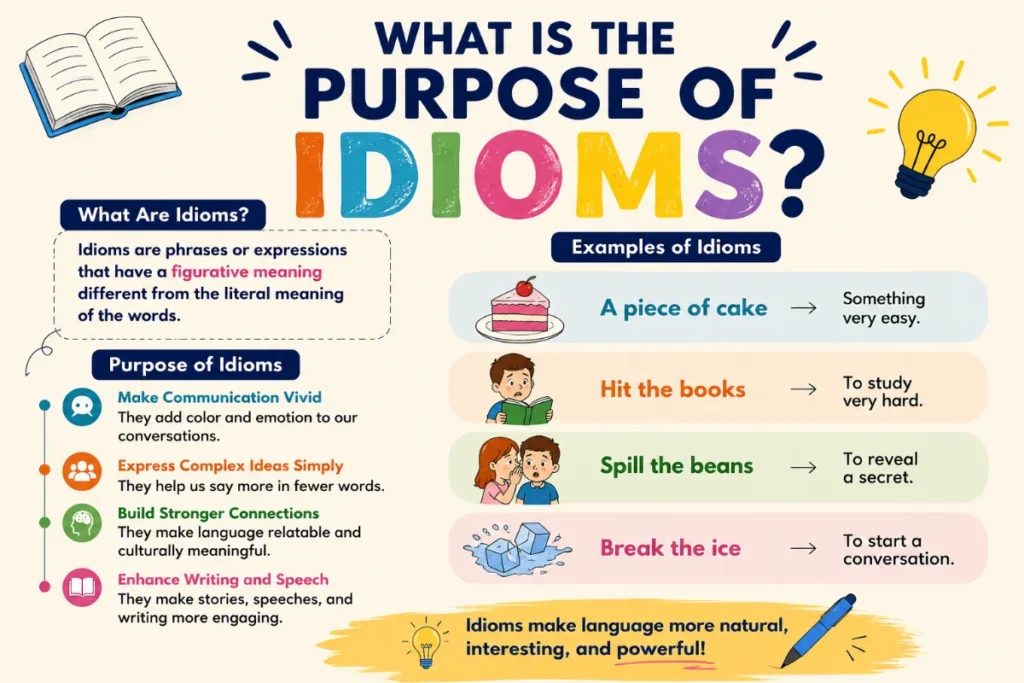
The purpose of idioms is to make language more expressive, memorable, and natural. Idioms communicate ideas, emotions, and situations in a figurative way instead of relying only on literal words.
Imagine a friend tells you, “Don’t worry about the test—it’s a piece of cake.” They are not talking about dessert. They mean the test will be easy. This is exactly why idioms are useful: a short expression can communicate an entire idea while creating a memorable mental picture.
Idioms appear in everyday conversations, movies, books, workplaces, classrooms, and online communication. For English learners, understanding idioms is especially important because the literal meaning of the individual words often does not explain what the speaker actually means.
In this guide, you’ll learn what is the purpose of idioms, why people use them, how they make communication more effective, and famous English idioms that demonstrate their different purposes.
Why Do We Use Idioms?
We use idioms to:
- Make communication more vivid and expressive
- Communicate familiar ideas quickly
- Add emotion, humor, or personality
- Make speech sound more natural
- Create memorable mental images
- Express cultural ideas and shared experiences
- Help speakers communicate attitudes and feelings indirectly
In simple terms, idioms give ordinary ideas a more colorful and recognizable form.
Why Do We Use Idioms?
Idioms are not simply decorative phrases added to make English sound complicated. They perform useful functions in communication.
1. To Make Language More Expressive
Compare these two sentences:
She was very happy.
and:
She was on cloud nine.
Both express happiness, but the idiom creates a stronger image and communicates the emotion more vividly.
Idioms allow speakers to add personality and imagery without using a long explanation.
2. To Communicate Ideas Quickly
An idiom can summarize a situation in only a few words.
Instead of saying:
“We should start the project and begin making progress.”
Someone might say:
“Let’s get the ball rolling.”
The expression is short, familiar, and easy to understand for someone who knows the idiom.
3. To Add Emotion and Personality
Idioms can make ordinary statements feel more energetic.
For example:
“I am extremely happy.”
is clear, but:
“I’m over the moon!”
sounds more enthusiastic and conversational.
The choice of idiom can communicate not only information but also the speaker’s attitude.
4. To Make Communication Memorable
Figurative expressions often create mental pictures.
When someone says:
“Break the ice.”
you can imagine ice breaking apart. That image makes the expression easier to remember than an abstract definition such as “make people feel comfortable.”
5. To Reflect Culture
Idioms are closely connected to the history and culture of a language.
Many expressions developed from everyday activities, traditions, stories, occupations, or shared experiences. As a result, learning idioms can also help English learners understand how native speakers use language in real cultural contexts.
6. To Sound More Natural in Conversation
Native speakers frequently use familiar idiomatic expressions in casual communication.
Knowing common idioms can therefore help learners:
- Follow conversations more easily
- Understand movies and television
- Interpret informal messages
- Improve listening comprehension
- Recognize figurative language
- Express themselves more naturally
However, using an idiom correctly is more important than using as many idioms as possible.
Literal Meaning vs. Figurative Meaning
One of the most important things to understand about idioms is that their figurative meaning is different from their literal meaning.
Consider:
Spill the beans.
Literal meaning
Someone could literally spill beans from a container.
Figurative meaning
The idiom means:
To reveal a secret or confidential information.
This difference is what makes idioms confusing for many English learners.
| Idiom | Literal Image | Figurative Meaning |
|---|---|---|
| A piece of cake | A piece of dessert | Something easy |
| Break the ice | Breaking ice | Make people feel comfortable |
| Spill the beans | Beans falling out | Reveal a secret |
| Hit the nail on the head | Hitting a nail accurately | Be exactly right |
| On cloud nine | Being on a cloud | Be extremely happy |
| Bite the bullet | Biting a bullet | Face something difficult |
| Hit the books | Hitting books | Study seriously |
Learning both sides of an idiom can make its meaning easier to remember.
A Piece of Cake
Meaning
A piece of cake means something that is very easy to do.
The literal image is a piece of cake, but the figurative meaning describes an easy task.
Example Sentences
- The homework was a piece of cake.
- Don’t worry about the interview; it will be a piece of cake.
Common Error
❌ “The exam was a piece of cakes.”
✅ “The exam was a piece of cake.”
Usage Note
This is a common informal expression used when talking about easy tasks or situations.
Break the Ice
Meaning
Break the ice means to make people feel more comfortable when they first meet or when a situation feels awkward.
The expression creates a picture of breaking through a cold or uncomfortable situation.
Example Sentences
- The teacher told a joke to break the ice.
- We played a quick game to break the ice at the meeting.
Common Error
❌ “He broke an ice.”
✅ “He broke the ice.”
Usage Note
Use this idiom when talking about introductions, meetings, parties, classrooms, or other social situations.
Hit the Nail on the Head
Meaning
Hit the nail on the head means to say or identify something exactly right.
The literal image is someone hitting a nail accurately.
Example Sentences
- You hit the nail on the head when you said the project needed better planning.
- Sarah hit the nail on the head with her explanation.
Common Error
❌ “You hit the nail in the head.”
✅ “You hit the nail on the head.”
Usage Note
Use it when someone gives an accurate explanation, observation, or answer.
Spill the Beans
Meaning
Spill the beans means to reveal a secret or information that was supposed to remain private.
Example Sentences
- Who spilled the beans about the surprise?
- Don’t spill the beans before the party.
Common Error
❌ “Please spill the bean.”
✅ “Please don’t spill the beans.”
Usage Note
This is an informal expression commonly used when talking about secrets, surprises, or confidential information.
Once in a Blue Moon
Meaning
Once in a blue moon means something happens very rarely.
Example Sentences
- I eat fast food once in a blue moon.
- We see our old neighbors once in a blue moon.
Common Error
❌ “I visit him in a blue moon.”
✅ “I visit him once in a blue moon.”
Usage Note
Remember the complete expression: once in a blue moon.
Under the Weather
Meaning
Under the weather means feeling slightly sick or unwell.
Example Sentences
- I’m feeling under the weather today.
- She stayed home because she was under the weather.
Common Error
❌ “I am under a weather.”
✅ “I am under the weather.”
Usage Note
This is generally informal and is often used for minor illness or generally feeling unwell.
Cost an Arm and a Leg
Meaning
Cost an arm and a leg means to be extremely expensive.
Example Sentences
- That car cost an arm and a leg.
- The vacation looked amazing, but it would cost an arm and a leg.
Common Error
❌ “It costs arms and legs.”
✅ “It costs an arm and a leg.”
Usage Note
This informal idiom emphasizes that something costs a lot of money.
Bite the Bullet
Meaning
Bite the bullet means to face a difficult or unpleasant situation with courage.
Example Sentences
- I don’t enjoy public speaking, but I’ll bite the bullet and give the presentation.
- She decided to bite the bullet and apologize.
Common Error
❌ “I bit a bullet to do it.”
✅ “I bit the bullet and did it.”
Usage Note
Use it when someone accepts that a difficult task or situation must be faced.
Let the Cat Out of the Bag
Meaning
Let the cat out of the bag means to accidentally reveal a secret.
Example Sentences
- Tom let the cat out of the bag about the surprise party.
- I wasn’t supposed to tell anyone, but Jane let the cat out of the bag.
Common Error
❌ “He let cat out from bag.”
✅ “He let the cat out of the bag.”
Usage Note
This informal idiom is similar to spill the beans.
Hit the Books
Meaning
Hit the books means to begin studying seriously.
Example Sentences
- I have an exam tomorrow, so I need to hit the books.
- She went home to hit the books.
Common Error
❌ “I hit my book for studying.”
✅ “I need to hit the books.”
Usage Note
This informal expression is especially common when talking about studying for exams.
Call It a Day
Meaning
Call it a day means to stop working on something for the day.
Example Sentences
- We’ve finished the important tasks. Let’s call it a day.
- I’m tired, so I’m going to call it a day.
Common Error
❌ “Let’s call today.”
✅ “Let’s call it a day.”
Usage Note
This expression is common in workplaces and everyday conversations.
Get the Ball Rolling
Meaning
Get the ball rolling means to start an activity, project, conversation, or process.
Example Sentences
- Let’s get the ball rolling on the new project.
- She asked the first question to get the ball rolling.
Common Error
❌ “Let’s get rolling the ball.”
✅ “Let’s get the ball rolling.”
Usage Note
This expression works well in professional, academic, and casual contexts.
On Cloud Nine
Meaning
On cloud nine means extremely happy or delighted.
Example Sentences
- She was on cloud nine after receiving the award.
- I’m on cloud nine because I got the job.
Common Error
❌ “I am on the cloud ninth.”
✅ “I am on cloud nine.”
Usage Note
Use this expression to describe intense happiness or excitement.
Beat Around the Bush
Meaning
Beat around the bush means to avoid discussing the main subject directly.
Example Sentences
- Stop beating around the bush and tell me what happened.
- The manager didn’t beat around the bush; she explained the problem immediately.
Common Error
❌ “Don’t beat on the bush.”
✅ “Don’t beat around the bush.”
Usage Note
Use this expression when someone is being indirect instead of getting to the point.
The Best of Both Worlds
Meaning
The best of both worlds means having the advantages of two different situations at the same time.
Example Sentences
- Working remotely gives me the best of both worlds.
- The new job offers the best of both worlds: flexibility and a good salary.
Common Error
❌ “The best from both worlds.”
✅ “The best of both worlds.”
Usage Note
This is useful when comparing choices or situations.
Actions Speak Louder Than Words
Meaning
Actions speak louder than words means that what someone does can be more meaningful or convincing than what they say.
Example Sentences
- He promised to help, but actions speak louder than words.
- She doesn’t talk about being generous; she simply helps people. Actions speak louder than words.
Common Error
❌ “Action speaks louder than word.”
✅ “Actions speak louder than words.”
Usage Note
This is a common proverb rather than a traditional idiom. It is included because it demonstrates another important type of figurative expression used in English.
Practice Makes Perfect
Meaning
Practice makes perfect expresses the idea that regular practice helps someone improve a skill.
Example Sentences
- Keep practicing your pronunciation. Practice makes perfect.
- Don’t give up after one mistake. Practice makes perfect.
Common Error
❌ “Practices make perfect.”
✅ “Practice makes perfect.”
Usage Note
This is also commonly classified as a proverb. It is frequently used to encourage learners and people developing a skill.
When Pigs Fly
Meaning
When pigs fly means something is extremely unlikely to happen.
Example Sentences
- He’ll clean his room when pigs fly.
- I’ll believe that story when pigs fly.
Common Error
❌ “When a pig will fly.”
✅ “When pigs fly.”
Usage Note
This is humorous and informal, so it is best suited to casual communication.
A Blessing in Disguise
Meaning
A blessing in disguise describes something that initially seems negative but eventually produces a positive result.
Example Sentences
- Losing that job was a blessing in disguise because I found a better career.
- The canceled trip turned out to be a blessing in disguise.
Common Error
❌ “It was a blessing under disguise.”
✅ “It was a blessing in disguise.”
Usage Note
Use this expression when a difficult or disappointing event eventually turns out to have a positive side.
The Last Straw
Meaning
The last straw means the final problem or unpleasant event that makes someone unable or unwilling to tolerate a situation anymore.
Example Sentences
- His rude comment was the last straw.
- Being late again was the last straw, so she quit.
Common Error
❌ “This was the last stick.”
✅ “This was the last straw.”
Usage Note
It is often used when frustration has been building over time.
What Do These Idioms Tell Us About the Purpose of Idioms?
These examples show that idioms serve different communication purposes.
| Purpose | Example | Meaning |
|---|---|---|
| Express happiness | On cloud nine | Extremely happy |
| Describe ease | A piece of cake | Very easy |
| Reveal information | Spill the beans | Reveal a secret |
| Start something | Get the ball rolling | Begin an activity |
| Describe rarity | Once in a blue moon | Very rarely |
| Face difficulty | Bite the bullet | Deal with something difficult |
| Describe high cost | Cost an arm and a leg | Very expensive |
| Encourage studying | Hit the books | Study seriously |
| Describe indirect speech | Beat around the bush | Avoid the main point |
| Describe an unlikely event | When pigs fly | Probably never |
The important point is that idioms do not all serve the same purpose. Some describe emotion, some describe behavior, some express attitude, and others make a situation easier to describe.
What Would English Sound Like Without Idioms?
One of the easiest ways to understand the purpose of idioms is to compare ordinary language with idiomatic language.
Without an Idiom
“The first few minutes of the meeting were uncomfortable, so I started a conversation.”
With an Idiom
“I tried to break the ice.”
The second sentence is shorter and creates a stronger mental image.
Another example:
Without an Idiom
“The assignment was extremely easy.”
With an Idiom
“The assignment was a piece of cake.”
Idioms do not necessarily make communication more accurate, but they can make it more vivid, familiar, and conversational.
Idioms vs. Proverbs: Are They the Same?
Idioms and proverbs are related forms of figurative language, but they are not exactly the same.
An idiom is a fixed expression whose overall meaning cannot always be understood from its individual words.
Example:
Break the ice = make people feel more comfortable.
A proverb is generally a short, familiar statement that expresses advice, wisdom, or a general observation.
Example:
Actions speak louder than words.
Another example:
Practice makes perfect.
This distinction matters because English learners sometimes call every figurative expression an idiom.
How Idioms Improve Everyday Communication
Idioms can make communication more effective in several ways.
They Add Imagery
Instead of simply saying:
“He is very happy.”
you can say:
“He’s on cloud nine.”
The listener gets a mental picture along with the meaning.
They Express Attitude
Compare:
“We need to start.”
with:
“Let’s get the ball rolling.”
The second sounds more conversational and energetic.
They Create Shared Understanding
Common expressions can function as shortcuts between people who already understand the same language and cultural conventions.
That’s one reason idioms appear so often in everyday speech.
When Should You Use Idioms?
Idioms are particularly useful in:
- Casual conversations
- Friendly messages
- Personal stories
- Interviews, when appropriate
- Informal presentations
- Everyday discussions
- Creative writing
- Entertainment and social media
However, context matters.
Idioms in Formal and Academic Writing
Not every idiom belongs in formal writing.
For example:
When pigs fly
is humorous and conversational.
By contrast, expressions such as:
A double-edged sword
can appear naturally in serious discussions and formal writing.
The best rule is simple:
Use an idiom when it improves clarity, tone, or expression—not simply because you know it.
How to Learn Idioms Effectively
Memorizing a list of definitions is rarely enough. The best way to learn idioms is to connect meaning + context + repetition + use.
Learn Five Idioms at a Time
Instead of memorizing 50 expressions in one sitting, start with five.
For example:
- Break the ice
- A piece of cake
- Hit the books
- Spill the beans
- On cloud nine
Learn the Whole Expression
Don’t memorize individual words separately.
Learn:
Break the ice = make people feel more comfortable
as one complete expression.
Study Idioms in Context
Compare:
Break the ice = make people comfortable.
with:
“I told a joke to break the ice at the meeting.”
The second example teaches you how the expression actually works in a sentence.
Create Your Own Examples
After learning an idiom, write a sentence connected to your real life.
For example:
“I need to hit the books tonight because I have an exam tomorrow.”
Personal examples are easier to remember.
Practice Speaking
Use new idioms in conversations when they fit naturally.
The goal isn’t to sound complicated. The goal is to understand and use expressions appropriately and naturally.
Idioms With Meanings: 40+ Phrases That Make English Click
Common Mistakes English Learners Make With Idioms
Translating Idioms Word by Word
This is one of the most common mistakes.
For example:
A piece of cake
does not mean “a piece of dessert” when it is being used idiomatically.
It means:
Something easy.
Changing Fixed Expressions
Many idioms have relatively fixed wording.
❌ “Break the ice cubes.”
✅ “Break the ice.”
Changing important words can make an expression sound unnatural.
Using an Idiom in the Wrong Context
An expression that works perfectly in a casual conversation may sound strange in an academic essay.
Always consider the audience and situation.
Using Too Many Idioms
Idioms can make language more interesting, but too many can make writing sound forced.
Good English is not about using an idiom in every sentence.
It’s about choosing the right expression at the right time.
Why Are Idioms Important for English Learners?
Idioms are important because real-world English contains much more than literal vocabulary.
A learner may know the words:
“spill” + “beans”
but still misunderstand:
“Who spilled the beans?”
Understanding the idiom allows the learner to recognize the intended meaning immediately.
Learning common idioms can help you:
- Understand native speakers
- Follow movies and shows
- Improve listening comprehension
- Understand informal messages
- Recognize figurative language
- Expand practical vocabulary
- Communicate more naturally
- Understand cultural references
The key is to prioritize common, useful idioms instead of trying to memorize every expression you encounter.
FAQ: What Is the Purpose of Idioms?
What is the main purpose of idioms?
The main purpose of idioms is to communicate familiar ideas, emotions, and situations in a vivid and culturally recognizable way. They can make language shorter, more expressive, and more natural.
Why are idioms important in English?
Idioms are important because they appear frequently in everyday conversations, entertainment, books, workplaces, and informal communication. Understanding them helps English learners understand meanings that cannot always be interpreted literally.
Do idioms make language more interesting?
Yes. Idioms can add imagery, emotion, humor, and personality. For example, “on cloud nine” creates a more vivid expression of happiness than simply saying “very happy.”
Should English learners use idioms?
Yes, but learners should use them selectively and appropriately. It is better to understand and correctly use a few common idioms than to force unfamiliar expressions into every conversation.
Are idioms appropriate in formal writing?
Some idioms can work in formal writing, while others are strongly conversational. Always consider your audience, purpose, and tone before using an idiomatic expression.
Now that you know why idioms matter, put them to use — explore translation idioms for cross-language insights. Teachers will love teaching English idioms, and word lovers can try 2-word idioms. For US favorites, see popular idioms in America.
Final Thoughts on the Purpose of Idioms
So, what is the purpose of idioms? Idioms help people communicate familiar ideas, emotions, attitudes, and situations in a way that is often more vivid and memorable than literal language.
From “a piece of cake” and “break the ice” to “bite the bullet” and “on cloud nine,” these expressions show how English can turn ordinary ideas into memorable phrases.
If you’re learning English, don’t try to memorize all 20 idioms at once. Choose five today, learn their figurative meanings, study the examples, and create your own sentences. Then try using at least one naturally in a real conversation.
The more you understand idioms in context, the easier it becomes to understand—and use—natural English.
6 More Idioms for Natural-Sounding English
These additional idioms come from our guide on using idioms naturally:
Kill Two Birds With One Stone
Meaning: To achieve two things with one action.
Example: I killed two birds with one stone by walking to work and getting exercise at the same time.
The Ball Is in Your Court
Meaning: It is now your responsibility to take action.
Example: I’ve done my part, so now the ball is in your court.
On the Same Page
Meaning: To have the same understanding as others.
Example: Before we start the project, let’s make sure we’re all on the same page.
Go the Extra Mile
Meaning: To do more than what is expected.
Example: She went the extra mile to help her friend with the presentation.
Pull Someone’s Leg
Meaning: To joke with or tease someone playfully.
Example: I’m just pulling your leg — you didn’t actually miss the deadline.
Get the Hang of It
Meaning: To learn how to do something after practice.
Example: It takes time, but you’ll get the hang of it soon.
When Should You Avoid Using Idioms?
Idioms are best for casual situations, not formal ones:
- Academic writing: Say “many students” instead of “a boatload of students.”
- Technical documents: Say “the system stopped working” instead of “the system bit the dust.”
- Legal situations: Say “he signed the contract” instead of “he signed on the dotted line.”
- International communication: Say “we are late” instead of “we are behind the eight ball.”
Idioms vs. Proverbs vs. Metaphors vs. Phrasal Verbs
| Type | Definition | Example | Function |
|---|---|---|---|
| Idiom | A phrase with a figurative meaning different from its words | Break the ice | Natural expression |
| Proverb | A short saying that gives advice or wisdom | Actions speak louder than words | Life lesson |
| Metaphor | A comparison saying something IS something else | He is a shining star | Imagery |
| Phrasal Verb | A verb plus a particle with a specific meaning | Give up | Action |
How to Practice Using Idioms: The 5-5-5 Method
Learn 5 idioms in 5 days and use each one 5 times in sentences:
| Idiom | My Sentence | Used? (1-5) |
|---|---|---|
| Break the ice | ||
| Piece of cake | ||
| Hit the books | ||
| Spill the beans | ||
| Once in a blue moon |
Quick Quiz: Test Your Understanding
1. What does “spill the beans” mean?
a) To cook beans
b) To reveal a secret
c) To drop food
2. Which idiom means something is very easy?
a) Break the ice
b) Piece of cake
c) Hit the books
3. What does “under the weather” describe?
a) Being sick
b) Being happy
c) Being outside
4. Which sentence uses an idiom correctly?
a) He kicked the bucket list yesterday.
b) She hit the books before the exam.
c) They let the dog out of the bag.
5. What should you avoid when using idioms in academic writing?
a) Using them too often
b) Using formal language
c) Using casual idioms like “a boatload of students”
Answers: 1-b, 2-b, 3-a, 4-b, 5-c

Daniel Mercer is a Meaning Match writer covering English idioms, vocabulary, expressions, and language usage with clear meanings and practical examples.