
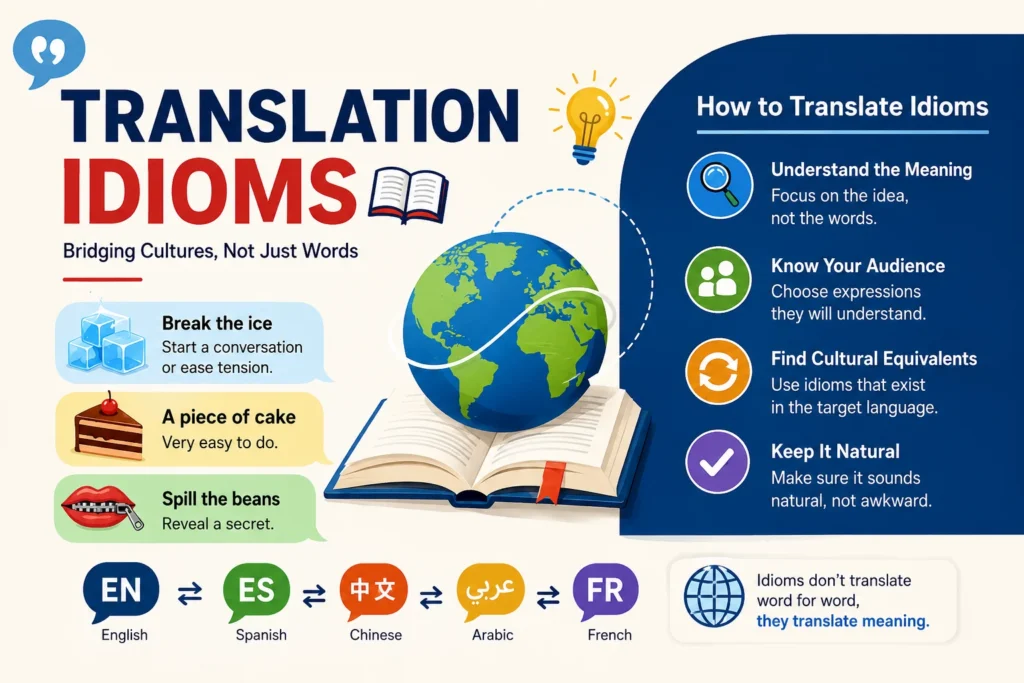
Translation idioms are expressions whose intended meaning cannot always be understood by translating each word literally. For example, “break the ice” means to make people feel comfortable, not to physically break frozen water.
Have you ever translated an English sentence word for word and ended up with something that sounds completely strange? Idioms are one of the biggest reasons this happens. Their meaning often comes from the whole expression, context, culture, and situation, rather than from the individual words.
This guide explains famous English idioms, including their literal meanings, figurative meanings, example sentences, common errors, usage notes, and practical translation strategies. You will also learn what to do when an idiom has no direct equivalent in another language.
To translate an idiom correctly, understand its figurative meaning first, consider its context and tone, then find a natural equivalent in the target language. If no equivalent exists, translate the intended meaning rather than the individual words.
Translation Idioms: Literal Meaning vs. Figurative Meaning
The most important rule in idiom translation is simple:
Translate the idea, not just the words.
Consider this example:
“The exam was a piece of cake.”
A literal translation focuses on the words piece and cake. But the speaker is not talking about dessert. The intended meaning is:
The exam was very easy.
This difference is what makes idiomatic expressions challenging for language learners and translators.
| English Idiom | Literal Meaning | Figurative Meaning | Translation Approach |
|---|---|---|---|
| Break the ice | Break frozen water | Start a friendly interaction | Find an equivalent or translate the meaning |
| A piece of cake | A piece of dessert | Something very easy | Use a natural expression for “very easy” |
| Spill the beans | Spill beans | Reveal a secret | Find an equivalent expression |
| Hit the books | Strike books | Study seriously | Translate the idea of studying |
| Under the weather | Beneath the weather | Feel unwell | Use the natural target-language expression |
A successful translation preserves the message and function of the original expression, even when the wording changes.
Break the Ice
Word-by-Word Meaning
Break means to separate, damage, or divide something, while ice is frozen water.
Taken literally, “break the ice” sounds as though someone is physically breaking a frozen surface.
Idiomatic/Figurative Meaning
Break the ice means to start a conversation or interaction that makes people feel more comfortable in an unfamiliar or awkward situation.
Example Sentences
- I told a funny story to break the ice at the meeting.
- The teacher played a game to break the ice on the first day of class.
Mini-dialogue:
A: “Everyone was quiet when the meeting started.”
B: “Yes, but Sarah told a joke and really broke the ice.”
Common Error
❌ Assuming the idiom describes physically breaking ice.
Translation Strategy
Look for an expression in the target language that means starting a friendly interaction or reducing social tension. If no equivalent exists, translate that meaning naturally instead of translating “break” and “ice” separately.
Usage Note
This is a common informal expression used in meetings, classrooms, interviews, parties, and first meetings.
A Piece of Cake
Word-by-Word Meaning
A piece of cake literally means one portion of a cake.
Idiomatic/Figurative Meaning
A piece of cake means something that is very easy to do.
Example Sentences
- The homework was a piece of cake.
- Once you understand the process, using the software is a piece of cake.
Mini-dialogue:
A: “Was the driving test difficult?”
B: “Not at all. It was a piece of cake.”
Common Error
❌ Assuming the speaker is talking about food when the context concerns difficulty.
Translation Strategy
Translate the idea of “very easy”. If the target language has a natural idiom meaning something is easy, that equivalent may be better than a literal translation.
Usage Note
This expression is informal and works especially well in everyday conversation.
Spill the Beans
Word-by-Word Meaning
Spill means to accidentally pour or scatter something, while beans are edible seeds.
Idiomatic/Figurative Meaning
Spill the beans means to reveal secret or private information.
Example Sentences
- Who spilled the beans about the surprise?
- Please don’t spill the beans before the announcement.
Mini-dialogue:
A: “Does Maya know about the party?”
B: “I think Tom spilled the beans yesterday.”
Common Error
❌ Using the expression when no secret or previously unknown information is involved.
Translation Strategy
Look for an equivalent expression meaning “reveal a secret.” If the target language has no natural idiom, translate the meaning directly.
Usage Note
It is informal and commonly used in conversations about secrets, surprises, and confidential information.
Hit the Books
Word-by-Word Meaning
Hit can mean to strike something, while books are written or digital materials used for reading and study.
Idiomatic/Figurative Meaning
Hit the books means to study seriously or intensely.
Example Sentences
- I need to hit the books before tomorrow’s exam.
- She spent the weekend hitting the books.
Common Error
❌ Assuming the phrase describes physical contact with books.
Translation Strategy
Translate the intended action: study hard or study seriously. A natural equivalent in the target language is more useful than preserving the literal image.
Usage Note
This is informal and particularly common among students.
Under the Weather
Word-by-Word Meaning
Literally, under the weather suggests being beneath weather conditions.
Idiomatic/Figurative Meaning
It means feeling sick, tired, or generally unwell.
Example Sentences
- I’m feeling under the weather today.
- Jake stayed home because he was under the weather.
Mini-dialogue:
A: “Are you coming to dinner tonight?”
B: “Probably not. I’m feeling a little under the weather.”
Common Error
❌ Assuming it refers to being physically outdoors during bad weather.
Translation Strategy
Translate the condition—feeling unwell—unless the target language has a natural equivalent idiom.
Usage Note
It is a common conversational expression for mild illness or feeling unwell.
Once in a Blue Moon
Word-by-Word Meaning
A blue moon refers to a moon described as blue, while once indicates one occurrence.
Idiomatic/Figurative Meaning
Once in a blue moon means very rarely.
Example Sentences
- I eat fast food once in a blue moon.
- We visit that restaurant once in a blue moon.
Common Error
❌ Using it for something that happens frequently or regularly.
Translation Strategy
Translate the frequency—very rarely—or use a target-language idiom that expresses the same idea.
Usage Note
This expression is informal and often adds a slightly colorful or humorous tone.
Cost an Arm and a Leg
Word-by-Word Meaning
An arm and a leg are parts of the human body.
Idiomatic/Figurative Meaning
Cost an arm and a leg means to be extremely expensive.
Example Sentences
- That luxury car cost an arm and a leg.
- The repairs didn’t cost an arm and a leg because we found a good mechanic.
Common Error
❌ Treating the phrase as a literal reference to body parts.
Translation Strategy
Look for an equivalent expression meaning extremely expensive. If the target language has a culturally natural idiom, it may communicate the same emphasis better.
Usage Note
This is an informal way to emphasize a surprisingly high cost.
Let the Cat Out of the Bag
Word-by-Word Meaning
Literally, the phrase describes releasing a cat from a bag.
Idiomatic/Figurative Meaning
Let the cat out of the bag means to reveal a secret, often accidentally.
Example Sentences
- Tom let the cat out of the bag about the engagement.
- Don’t let the cat out of the bag before Saturday.
Common Error
❌ Using it for ordinary information that was never intended to be secret.
Translation Strategy
Translate the idea of revealing a secret, preferably with an equivalent idiom if one naturally exists.
Usage Note
It is informal and often suggests an accidental revelation.
When Pigs Fly
Word-by-Word Meaning
The literal image describes pigs flying through the air.
Idiomatic/Figurative Meaning
When pigs fly means something is extremely unlikely or will probably never happen.
Example Sentences
- He’ll clean his room when pigs fly.
- I’ll believe that story when pigs fly.
Common Error
❌ Using it for something that is merely difficult rather than highly unlikely.
Translation Strategy
Translate the idea of “probably never” or find a humorous equivalent in the target language.
Usage Note
This is humorous, informal, and often used to express disbelief.
Beat Around the Bush
Word-by-Word Meaning
The literal image suggests moving around a bush rather than approaching something directly.
Idiomatic/Figurative Meaning
Beat around the bush means to avoid discussing the main point directly.
Example Sentences
- Stop beating around the bush and tell me what happened.
- The manager kept beating around the bush instead of answering the question.
Common Error
❌ Using it when someone is simply taking time to explain something carefully.
Translation Strategy
Translate the communicative meaning: avoid the main point or speak indirectly.
Usage Note
It is useful when someone is avoiding a direct answer or important subject.
Bite the Bullet
Word-by-Word Meaning
To bite the bullet literally means to put a bullet between your teeth.
Idiomatic/Figurative Meaning
It means to face a difficult or unpleasant situation with courage and determination.
Example Sentences
- I finally bit the bullet and apologized.
- She decided to bite the bullet and start the difficult project.
Common Error
❌ Assuming the phrase only applies to physical danger.
Translation Strategy
Focus on the idea of accepting something difficult and dealing with it bravely.
Usage Note
It can describe emotional, professional, financial, or practical difficulties.
Call It a Day
Word-by-Word Meaning
The literal wording suggests deciding to call something “a day.”
Idiomatic/Figurative Meaning
Call it a day means to stop working on something for the time being.
Example Sentences
- We’ve worked for eight hours. Let’s call it a day.
- I’m exhausted, so I’m going to call it a day.
Common Error
❌ Assuming it can only be used when the entire calendar day has ended.
Translation Strategy
Translate the intended meaning: stop working for now or finish for today.
Usage Note
This expression is common in workplaces and everyday conversation.
On Cloud Nine
Word-by-Word Meaning
A cloud is a visible mass in the sky, and nine is a number.
Idiomatic/Figurative Meaning
On cloud nine means extremely happy or delighted.
Example Sentences
- She was on cloud nine after receiving the scholarship.
- He has been on cloud nine since the wedding.
Common Error
❌ Assuming it describes a physical location.
Translation Strategy
Translate the emotion—extremely happy—or use an equivalent expression for intense happiness.
Usage Note
This expression is useful when describing strong positive emotions.
Kill Two Birds with One Stone
Word-by-Word Meaning
The literal image involves using one stone to kill two birds.
Idiomatic/Figurative Meaning
It means to accomplish two goals with one action.
Example Sentences
- I killed two birds with one stone by walking to work and exercising.
- We can kill two birds with one stone by visiting the bank while shopping nearby.
Common Error
❌ Using it when an action accomplishes only one objective.
Translation Strategy
Translate the underlying concept—achieve two goals at once. In contexts where the violent imagery is undesirable, a neutral alternative can be used.
Usage Note
It is common in informal and professional English, although alternatives such as “achieve two goals at once” may be preferable in some contexts.
Add Fuel to the Fire
Word-by-Word Meaning
Fuel is material that helps a fire burn.
Idiomatic/Figurative Meaning
Add fuel to the fire means to make an already difficult, angry, or tense situation worse.
Example Sentences
- His rude comment added fuel to the fire.
- Arguing now will only add fuel to the fire.
Common Error
❌ Using the expression when there is no existing problem or conflict.
Translation Strategy
Communicate the idea of making a bad situation worse. An equivalent metaphor can be used if one exists naturally in the target language.
Usage Note
It is particularly common when discussing conflict, arguments, or escalating problems.
The Ball Is in Your Court
Word-by-Word Meaning
The phrase comes from sports, where the ball can be on one player’s side of the court.
Idiomatic/Figurative Meaning
The ball is in your court means it is now your responsibility or turn to take action or make a decision.
Example Sentences
- I’ve sent you the proposal. The ball is in your court now.
- I’ve explained my position, so the ball is in your court.
Common Error
❌ Assuming the expression is restricted to sports.
Translation Strategy
Translate the functional meaning: it is your turn to act or decide.
Usage Note
This expression works particularly well in professional, negotiation, and relationship contexts.
Go the Extra Mile
Word-by-Word Meaning
Going an extra mile literally means traveling one additional mile.
Idiomatic/Figurative Meaning
Go the extra mile means to make more effort than is normally expected.
Example Sentences
- Our customer-service team always goes the extra mile.
- She went the extra mile to help her colleague.
Common Error
❌ Using it when someone simply completes an ordinary responsibility.
Translation Strategy
Translate the idea of making an extra effort. A natural target-language expression is preferable to a literal reference to distance.
Usage Note
This expression is common in professional, educational, and personal contexts.
Pull Someone’s Leg
Word-by-Word Meaning
To pull someone’s leg literally means to physically pull a person’s leg.
Idiomatic/Figurative Meaning
It means to joke with or tease someone by pretending something is true.
Example Sentences
- Don’t worry—I’m just pulling your leg.
- He was pulling my leg when he said he had won the lottery.
Common Error
❌ Assuming the speaker is describing physical contact.
Translation Strategy
Translate the communicative function: joking, teasing, or pretending something is true for fun.
Usage Note
This is informal and is usually friendly, although context determines whether the joke is appropriate.
In Hot Water
Word-by-Word Meaning
Literally, being in hot water means being surrounded by hot water.
Idiomatic/Figurative Meaning
In hot water means to be in trouble or facing difficulties.
Example Sentences
- He is in hot water with his manager.
- She got in hot water after missing the deadline.
Common Error
❌ Using it only to describe physical contact with hot water.
Translation Strategy
Translate the intended idea: being in trouble. A target-language idiom with the same meaning can be even more natural.
Usage Note
It is a common informal expression for problems or trouble.
A Blessing in Disguise
Word-by-Word Meaning
A blessing is something beneficial or fortunate, while a disguise hides the true appearance of something.
Idiomatic/Figurative Meaning
A blessing in disguise is something that initially appears negative but eventually produces a positive result.
Example Sentences
- Losing that job turned out to be a blessing in disguise.
- Missing the flight was a blessing in disguise because the later flight was safer.
Common Error
❌ Using the expression when there is no eventual positive benefit.
Translation Strategy
Preserve the contrast between an apparently bad event and its unexpectedly positive outcome.
Usage Note
This expression is useful when reflecting on disappointing events that later prove beneficial.
How Should You Translate an English Idiom?
Translating an idiom successfully requires more than finding dictionary definitions. A practical approach is to move through the following steps.
1. Identify the Idiom
First determine whether the expression is actually being used idiomatically.
For example:
“She spilled the beans.”
If the context is about a secret, spill the beans is an idiom.
If someone literally spilled a container of beans, it is not.
2. Understand the Figurative Meaning
Ask:
What is the speaker actually trying to communicate?
For “spill the beans,” the answer is:
Reveal a secret.
3. Consider the Context
The same basic meaning can require different wording depending on the situation.
Consider:
- Who is speaking?
- Who is listening?
- Is the situation formal or informal?
- Is the speaker joking?
- Is the expression sarcastic?
- What is the cultural context?
4. Look for a Natural Equivalent
If the target language has an idiom that communicates essentially the same meaning and tone, use it.
This is often better than preserving the English imagery.
5. Use Descriptive Translation When Necessary
Not every idiom has a perfect equivalent.
In that situation, translate the meaning clearly.
For example:
A piece of cake → Very easy
This may lose the original imagery but successfully communicates the message.
6. Check the Final Translation
Ask:
Would a natural speaker of the target language actually say this?
If the answer is no, revise the translation.
Three Ways to Translate Idioms
Not every idiom should be handled in exactly the same way.
Direct Equivalent
A direct equivalent exists when the target language has an expression with essentially the same meaning and similar usage.
This is often the easiest option.
Similar Idiom
Sometimes the target language uses completely different imagery to communicate the same idea.
The words may change, but the function and meaning remain similar.
Descriptive Translation
When no natural equivalent exists, explain the meaning directly.
For example:
Hit the books → Study seriously
This approach is often clearer than creating an unnatural literal translation.
How to Translate Idioms When There Is No Equivalent
This is one of the most important challenges in idiom translation.
If you cannot find a direct equivalent, don’t force one.
Instead:
Identify the Core Meaning
Ask what the expression communicates rather than what its individual words describe.
Preserve the Tone
A humorous English idiom should not automatically become an extremely formal sentence in translation.
Preserve the Function
If the idiom is used to persuade, joke, criticize, reassure, or express emotion, try to preserve that function.
Consider Cultural Relevance
An image that is familiar in one culture may be confusing or meaningless in another.
Use Clear Descriptive Language
If necessary, explain the meaning naturally rather than preserving an unfamiliar metaphor.
The goal is meaningful communication, not word-for-word similarity.
What Is the Purpose of Idioms? The Real Reason We Don’t Speak Literally
Why Are Translation Idioms Difficult?
Cultural Differences
Idioms often develop from a language’s history, traditions, sports, food, literature, or everyday experiences.
An expression that makes perfect sense to native speakers may seem completely strange to someone from another linguistic background.
Figurative Meaning
The words themselves may not reveal the intended message.
For example:
Hit the books
does not mean physically striking books.
Context
The surrounding sentence can determine whether an expression is literal or idiomatic.
Compare:
“He spilled the beans on the table.”
with:
“He spilled the beans about the surprise.”
The first can be literal; the second is clearly idiomatic.
Tone and Register
Some idioms are:
- casual
- humorous
- conversational
- emotional
- sarcastic
- professional
A translation should preserve the appropriate level of formality whenever possible.
Common Mistakes When Translating Idioms
Translating Every Word Literally
This is the most common mistake.
❌ A piece of cake = a piece of dessert
✅ A piece of cake = something very easy
Ignoring Context
The same words can be literal in one sentence and idiomatic in another.
Always read the surrounding sentence or paragraph.
Choosing an Unnatural Equivalent
An expression may technically have the same meaning but sound strange in the target language.
Naturalness matters.
Ignoring Cultural Meaning
Some idioms depend heavily on cultural references. A translator needs to consider what the target audience will understand.
Changing the Tone
Turning a playful idiom into an overly formal expression can change the speaker’s personality and intention.
Assuming Every Idiom Has a Perfect Match
Many expressions do not have one-to-one equivalents. Sometimes the best translation is a clear explanation of the intended meaning.
Use of Idioms: The Secret Behind Natural-Sounding English
Translation Idioms vs. Literal Translation
| Feature | Idiomatic Translation | Literal Translation |
|---|---|---|
| Main focus | Intended meaning | Individual words |
| Context | Extremely important | Often less important |
| Cultural awareness | Often necessary | May be limited |
| Word order | Can change | Often preserved |
| Imagery | May change | Usually preserved |
| Naturalness | Prioritized | May be reduced |
| Example | “Spill the beans” → reveal a secret | “Spill” + “beans” |
The key difference is that idiomatic translation prioritizes what the speaker means, while literal translation focuses more heavily on what the original words say.
How to Learn Translation Idioms Effectively
Memorizing a long list of definitions is rarely enough. A better approach connects meaning, context, repetition, and active use.
Learn Five Idioms at a Time
Start with a small group:
- Break the ice
- A piece of cake
- Spill the beans
- Hit the books
- Go the extra mile
Learn these thoroughly before adding another group.
Learn the Whole Expression
Don’t memorize only individual words.
Learn:
Spill the beans = reveal a secret
as one complete unit.
Compare Literal and Figurative Meanings
Understanding the contrast can make unusual expressions easier to remember.
Study Real Examples
Notice how native speakers use an idiom in conversations, articles, videos, and everyday situations.
Create Your Own Sentences
For example:
“I was nervous at first, but my new classmates helped break the ice.”
Creating your own example forces you to understand when the expression is appropriate.
Review Regularly
Review new idioms after a day, several days, and again later. Repeated exposure makes them easier to recognize and use naturally.
When Should You Use English Idioms?
Not every idiom belongs in every situation.
Casual Conversation
Idioms are often natural in:
- conversations with friends
- everyday discussions
- informal messages
- storytelling
- social situations
Professional Communication
Some common idioms can work well in professional English, especially familiar expressions such as:
Go the extra mile
or
The ball is in your court.
However, always consider your audience.
Academic Writing
Academic writing usually favors precise language. An idiom may sometimes work, but it should not replace a clearer technical expression when precision matters.
For example:
Informal:
The project was a piece of cake.
More formal:
The project was relatively straightforward.
The best choice depends on purpose, audience, and tone.
Key Takeaways About Translation Idioms
- Don’t translate idioms word for word automatically.
- Identify the figurative meaning first.
- Always consider context and tone.
- Look for a natural equivalent in the target language.
- Use descriptive translation when no equivalent exists.
- Consider cultural differences.
- Preserve the original expression’s function and intended message.
- Learn idioms through examples and real contexts.
- Remember that a natural translation may use completely different words from the original.
- The goal is to communicate the same meaning naturally and accurately.
Frequently Asked Questions About Translation Idioms
What are translation idioms?
Translation idioms are idiomatic expressions that require special attention when moving from one language to another because their intended meaning may differ from their literal wording.
How do you translate English idioms?
First identify the figurative meaning, then consider context, tone, and culture. Look for a natural equivalent in the target language. If no equivalent exists, translate the intended meaning descriptively.
Should idioms be translated literally?
Usually, no. Literal translation can produce confusing or unnatural results. The translator should normally prioritize the intended meaning, although a literal translation can be appropriate when the expression is actually being used literally.
What happens when an idiom has no equivalent in another language?
Use a similar idiom if one exists. Otherwise, translate the meaning clearly and naturally. Preserving the message is more important than preserving every word or image.
What is the difference between literal and figurative meaning?
Literal meaning refers to the direct meaning of the words. Figurative meaning refers to the idea or message that the complete expression communicates beyond its literal wording.
Why are idioms difficult for English learners?
Idioms can be difficult because their meanings are often unpredictable from individual words. Cultural references, context, tone, and fixed wording can make them even harder to understand.
Idioms don’t always translate neatly — master the essentials with idioms with meanings and examples. Compare British expressions and idioms with popular idioms in America, and find teaching tips in teaching English idioms.
Final Thoughts on Translation Idioms
Learning translation idioms is not simply about memorizing unusual English phrases. It is about learning how language communicates ideas beyond individual words.
When you encounter an unfamiliar idiom, don’t immediately translate every word. Stop, look at the context, identify the figurative meaning, and ask whether your language has a natural equivalent. If it doesn’t, communicate the meaning clearly rather than forcing a literal translation.
Start with the 20 idioms in this guide. Choose five, learn their meanings, study the examples, and create your own sentences. With regular practice, expressions such as “break the ice,” “spill the beans,” “a piece of cake,” and “go the extra mile” will become much easier to recognize, understand, translate, and use naturally.
The goal isn’t to translate every word perfectly. The goal is to make the meaning feel natural.

Sophie Collins writes for Meaning Match about English idioms, American and British expressions, meanings, usage, and everyday language differences.