
Have you ever heard someone say “it’s raining cats and dogs” and wondered how cats and dogs could possibly fall from the sky? That’s because an idiom has a special meaning that is different from the exact meaning of its words.
Idioms for 3rd grade can seem confusing at first, but fun examples and simple explanations make them easier to understand. For example, “a piece of cake” does not mean a slice of dessert—it means something is very easy.
Learning idioms can help third graders build vocabulary and better understand the expressions they see in books, conversations, and everyday writing. Whether you’re a student, parent, or teacher, this guide features kid-friendly idioms with simple meanings and clear example sentences. You’ll discover fun expressions, learn what they really mean, and see how to use them naturally in a sentence.
What Are Idioms for 3rd Grade?
Idioms for 3rd grade are fun phrases whose real meanings are different from their literal words. For example, if someone says, “This test is a piece of cake,” they mean the test is very easy—not that it is made of cake.
Learning common idioms helps children understand stories, conversations, and everyday English while making their own speaking and writing more interesting.
Quick List: Easy Idioms for 3rd Graders
| # | Idiom | Simple Meaning |
|---|---|---|
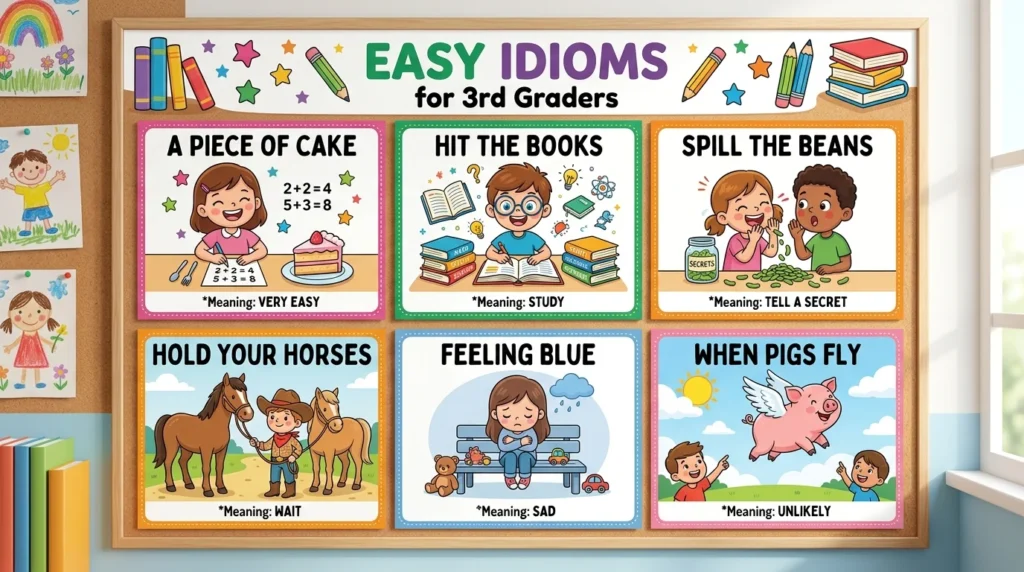
| 1 | A piece of cake | Very easy |
| 2 | Break the ice | Start a friendly conversation |
| 3 | Hit the books | Study |
| 4 | Under the weather | Feel sick |
| 5 | Spill the beans | Reveal a secret |
| 6 | Let the cat out of the bag | Reveal a secret |
| 7 | When pigs fly | Something unlikely to happen |
| 8 | Hold your horses | Wait or slow down |
| 9 | Keep an eye on | Watch carefully |
| 10 | Once in a blue moon | Very rarely |
| 11 | Cost an arm and a leg | Very expensive |
| 12 | Feeling blue | Feeling sad |
| 13 | In hot water | In trouble |
| 14 | Go the extra mile | Try extra hard |
| 15 | Best of both worlds | Enjoy two good things |
| 16 | Barking up the wrong tree | Looking in the wrong place |
| 17 | On cloud nine | Very happy |
| 18 | A storm in a teacup | A small problem made to seem bigger |
| 19 | The ball is in your court | It is your turn to act |
| 20 | Keep your chin up | Stay hopeful and positive |
Easy Everyday Idioms
These are great starting points for young learners because they are simple, memorable, and useful in everyday situations.
A Piece of Cake
Word-by-word meaning: A piece of cake or dessert.
Idiomatic meaning: Something that is very easy.
Examples:
- The puzzle was a piece of cake.
- My spelling test was a piece of cake.
Common error: It does not mean that the task is actually made of cake.
Usage note: Use it in casual conversations when something is easy.
Break the Ice
Word-by-word meaning: To break ice.
Idiomatic meaning: To help people feel comfortable and start talking.
Examples:
- Our teacher told a joke to break the ice.
- I asked my new classmate about her favorite game to break the ice.
Common error: It usually does not mean breaking real ice.
Usage note: This is useful when people meet for the first time.
Hit the Books
Word-by-word meaning: To hit books.
Idiomatic meaning: To study.
Examples:
- I have a test tomorrow, so I need to hit the books.
- Sam went home to hit the books.
Common error: You should not literally hit your schoolbooks.
Usage note: This is an informal expression often used by students.
Under the Weather
Word-by-word meaning: To be underneath the weather.
Idiomatic meaning: To feel sick or unwell.
Examples:
- Mia stayed home because she was under the weather.
- I felt under the weather yesterday.
Common error: It does not mean standing under rain or clouds.
Usage note: Use it when someone is not feeling well.
Spill the Beans
Word-by-word meaning: To spill beans.
Idiomatic meaning: To reveal a secret.
Examples:
- Don’t spill the beans about the surprise.
- Ben spilled the beans about the party.
Common error: The beans are not necessarily real beans.
Usage note: This is an informal expression for revealing secret information.
Let the Cat Out of the Bag
Word-by-word meaning: To let a cat escape from a bag.
Idiomatic meaning: To reveal a secret, often by accident.
Examples:
- Lily let the cat out of the bag about the gift.
- I almost let the cat out of the bag.
Common error: The phrase is about revealing information, not releasing a real cat.
Usage note: It is commonly used for surprises and secrets.
When Pigs Fly
Word-by-word meaning: When pigs fly through the air.
Idiomatic meaning: Something that is very unlikely to happen.
Examples:
- I will clean my room when pigs fly!
- “Will our dog learn to talk?” “When pigs fly!”
Common error: Do not use it for something that is likely to happen.
Usage note: It is usually used in a funny way to mean “probably never.”
Hold Your Horses
Word-by-word meaning: To hold horses.
Idiomatic meaning: To wait or slow down.
Examples:
- Hold your horses! We are not ready yet.
- Hold your horses and listen to the instructions.
Common error: You do not have to hold a real horse.
Usage note: It is informal and can sound playful.
Keep an Eye On
Word-by-word meaning: To keep an eye looking at something.
Idiomatic meaning: To watch or look after something carefully.
Examples:
- Please keep an eye on my backpack.
- Can you keep an eye on the cookies?
Common error: It does not mean giving away or removing an eye.
Usage note: This is a very useful everyday expression.
Once in a Blue Moon
Word-by-word meaning: Something happening during a blue moon.
Idiomatic meaning: Something that happens very rarely.
Examples:
- We eat at that restaurant once in a blue moon.
- I play that old game once in a blue moon.
Common error: It does not mean something happens regularly.
Usage note: Use it when something happens only occasionally.
Teaching English Idioms: Practical Ways to Make Them Stick
More Fun Idioms for 3rd Grade
The next ten expressions are a little more challenging. They are useful for expanding a child’s vocabulary and understanding of figurative language.
Cost an Arm and a Leg
Word-by-word meaning: To give up an arm and a leg.
Idiomatic meaning: Something is very expensive.
Examples:
- That bicycle cost an arm and a leg.
- The new game console costs an arm and a leg.
Common error: Nobody is literally paying with body parts.
Usage note: This is an informal expression about high prices.
Feeling Blue
Word-by-word meaning: Feeling the color blue.
Idiomatic meaning: Feeling sad.
Examples:
- Mia was feeling blue after her friend moved away.
- I was feeling blue, so my brother cheered me up.
Common error: It does not mean someone has turned blue.
Usage note: Use it for ordinary feelings of sadness.
In Hot Water
Word-by-word meaning: Being in hot water.
Idiomatic meaning: To be in trouble.
Examples:
- Tom was in hot water after breaking the classroom rule.
- I may be in hot water if I forget my homework.
Common error: It does not simply mean taking a hot bath.
Usage note: This is an informal way to talk about getting into trouble.
Go the Extra Mile
Word-by-word meaning: To walk one more mile.
Idiomatic meaning: To try extra hard to help or do something.
Examples:
- Our teacher went the extra mile to help us.
- Sara went the extra mile to make a beautiful card.
Common error: You do not have to literally walk a mile.
Usage note: Use it when someone makes extra effort.
Best of Both Worlds
Word-by-word meaning: Having the best things from two worlds.
Idiomatic meaning: Getting two good things at the same time.
Examples:
- The park has a playground and a library, so we get the best of both worlds.
- Our trip gave us the best of both worlds: learning and fun.
Common error: It does not mean living in two real worlds.
Usage note: Use it when two advantages come together.
Barking Up the Wrong Tree
Word-by-word meaning: A dog barking at the wrong tree.
Idiomatic meaning: Looking for an answer in the wrong place or blaming the wrong person.
Examples:
- If you think I ate the cookies, you’re barking up the wrong tree.
- We searched the wrong classroom. We were barking up the wrong tree.
Common error: The expression is not really about a dog and a tree.
Usage note: It is a fun, humorous idiom that works well in stories.
On Cloud Nine
Word-by-word meaning: Being on a cloud.
Idiomatic meaning: Feeling extremely happy.
Examples:
- I was on cloud nine when I won the contest.
- Sara was on cloud nine after getting a puppy.
Common error: It does not mean someone is actually sitting on a cloud.
Usage note: Use it for moments of great happiness.
. A Storm in a Teacup
Word-by-word meaning: A storm inside a teacup.
Idiomatic meaning: A small problem that gets too much attention.
Examples:
- Their little argument was just a storm in a teacup.
- The missing pencil caused a storm in a teacup.
Common error: There is no real storm inside the cup.
Usage note: This expression is more common in British English, so it can be treated as a challenge idiom for Grade 3 learners.
The Ball Is in Your Court
Word-by-word meaning: A ball is on your side of a court.
Idiomatic meaning: It is your turn to decide or take action.
Examples:
- I gave you the choices. Now the ball is in your court.
- I’ve finished my part, so the ball is in your court.
Common error: It can be used outside sports.
Usage note: Use it when someone else needs to make the next move.
Keep Your Chin Up
Word-by-word meaning: To hold your chin upward.
Idiomatic meaning: To stay hopeful and positive when things are difficult.
Examples:
- Keep your chin up! You can try again.
- My teacher told me to keep my chin up after I made a mistake.
Common error: It does not simply mean lifting your chin.
Usage note: Use it to encourage someone who feels disappointed.
What Should a 3rd Grader Know About Idioms?
After learning these expressions, a student should be able to:
- Explain what an idiom is in simple words.
- Tell the difference between literal and figurative meanings.
- Recognize common idioms while reading.
- Explain an idiom using their own words.
- Use simple idioms correctly in sentences.
- Understand that changing an idiom’s words can change or ruin the expression.
Literal vs. Figurative Meaning
This is one of the most important ideas for children learning idioms.
| Idiom | Literal Meaning | Real Meaning |
|---|---|---|
| A piece of cake | A piece of dessert | Something easy |
| Hit the books | Hit books | Study |
| Spill the beans | Drop beans | Reveal a secret |
| Feeling blue | Feel a color | Feel sad |
| Hold your horses | Hold horses | Wait |
| On cloud nine | Sit on a cloud | Feel very happy |
A Simple Trick
When an expression sounds strange, ask:
“Does this make sense if I understand every word literally?”
If not, it may be an idiom.
For example:
“I need to hit the books.”
You should not start punching your textbooks. The speaker means:
“I need to study.”
How to Practice 3rd Grade Idioms
Draw the Literal Meaning
For “When pigs fly,” draw a pig flying through the sky. Then write its real meaning: something very unlikely to happen.
Match Idioms and Meanings
Match:
- A piece of cake → Something easy
- Spill the beans → Reveal a secret
- Hit the books → Study
- Feeling blue → Feeling sad
Write Your Own Sentence
Choose one idiom and make a sentence about your own life.
Idiom: On cloud nine
Sentence: “I was on cloud nine when my team won the game.”
Use an Idiom of the Day
Pick one expression each day. Students can:
- Read the idiom.
- Explain its meaning.
- Draw it literally.
- Write one sentence using it.
This takes only a few minutes but gives children regular practice.
Common Mistakes Students Make With Idioms
Taking Idioms Literally
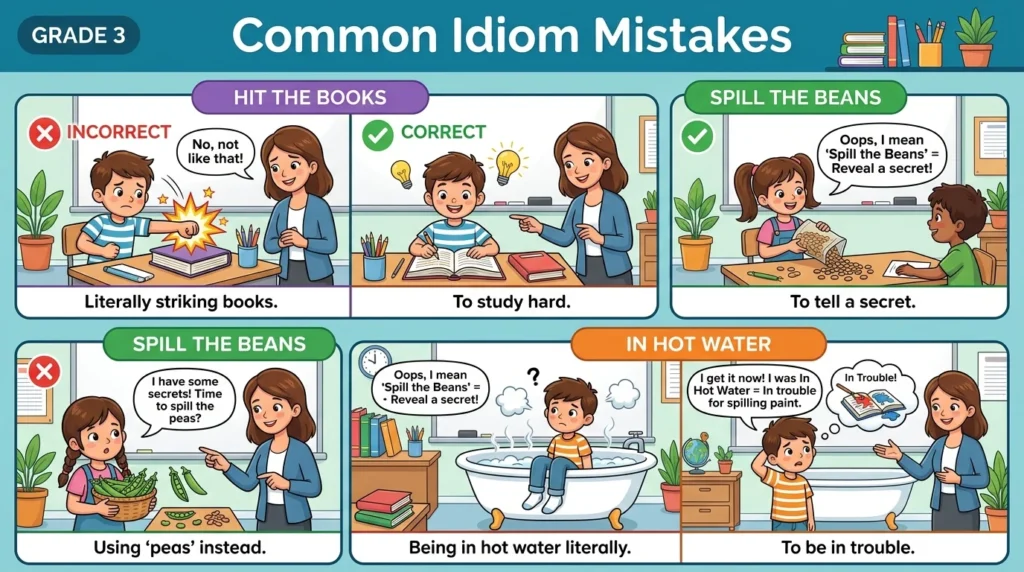
If someone says “Hit the books,” they mean study, not punch a book.
Changing the Words
Idioms usually have a fixed form.
Correct: Spill the beans.
Incorrect: Spill the peas.
Even though peas and beans are both foods, changing the expression can make it sound wrong.
Using an Idiom in the Wrong Situation
Learn the meaning and context before using a new expression.
For example, “in hot water” means in trouble. It should not be used simply because someone is taking a warm bath.
Using Too Many Idioms
Idioms can make writing fun, but using one in every sentence can make writing confusing. A few well-chosen expressions are usually better.
Flocabulary Idioms: 23+ Expressions With Meanings and Examples
Quick 3rd Grade Idiom Quiz
1. Emma studied for her spelling test all evening. Which idiom fits?
A. Spill the beans
B. Hit the books
C. When pigs fly
Answer: B. Hit the books
2. “Don’t tell anyone about my surprise party!” Which idiom fits?
A. Spill the beans
B. On cloud nine
C. Keep your chin up
Answer: A. Spill the beans
3. Jake won the school drawing contest and felt extremely happy. Which idiom fits?
A. In hot water
B. Feeling blue
C. On cloud nine
Answer: C. On cloud nine
4. Your friend is rushing, but you need them to wait. What could you say?
A. Hold your horses!
B. Break the ice!
C. Spill the beans!
Answer: A. Hold your horses!
5. Someone thinks you broke the window, but you did not. What could you say?
A. It’s a piece of cake.
B. You’re barking up the wrong tree.
C. I’m on cloud nine.
Answer: B. You’re barking up the wrong tree.
Frequently Asked Questions About 3rd Grade Idioms
What is an idiom for a 3rd grader?
An idiom is a phrase that has a special meaning different from its literal words. For example, “a piece of cake” means something is very easy.
What are some easy idioms for 3rd graders?
Some easy choices are a piece of cake, hit the books, spill the beans, hold your horses, keep an eye on, feeling blue, and keep your chin up.
Why should 3rd graders learn idioms?
Idioms help children understand figurative language in stories, books, conversations, and everyday English. They can also make speaking and writing more expressive.
How can children learn idioms easily?
Start with a few common expressions. Learn each meaning, look at examples, draw the literal idea, and create an original sentence.
Are idioms literal or figurative?
Idioms are generally figurative. Their real meaning is different from the exact meaning of their individual words.
Conclusion
Learning idioms for 3rd grade does not have to be difficult. Start with a few familiar expressions, learn what they really mean, and practice using them in simple sentences.
The easiest way to remember an idiom is to see it, understand it, and use it. Pick one idiom today, make your own sentence, and try using it in a conversation or story. With regular practice, figurative language will become easier—and learning idioms can become a piece of cake!

Emily Carter writes for Meaning Match about English idioms, student-friendly expressions, and language learning, using simple explanations and helpful examples.