
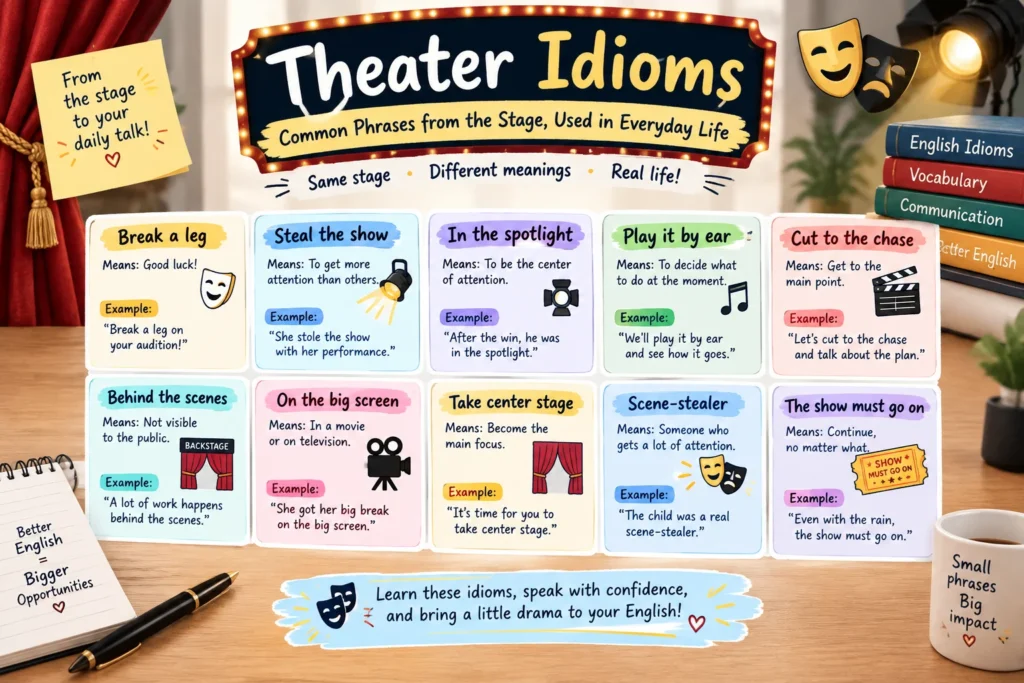
If you’ve heard a theater expression that made little sense when taken literally, you’re not alone. Theater idioms are idiomatic expressions and familiar sayings associated with acting, stage performance, rehearsals, and the theater world. Their meanings often go beyond the literal words, which can make them confusing for people unfamiliar with theater language.
Some are true idioms, while others are theater-specific expressions, stage terms, or traditional sayings. For example, “break a leg” is a famous expression traditionally used to wish a performer good luck, while “steal the show” means to attract the most attention or give an especially impressive performance. Both expressions are strongly associated with performance, although they can also be used in everyday English.
This guide explains common theater idioms, acting expressions, stage sayings, and theater terms, with simple meanings, examples, and useful context so you can understand exactly what each expression means and when to use it.
What Are Theater Idioms?
Theater idioms are idioms, figurative expressions, and stage-related phrases that have meanings beyond their literal theatrical sense. Common examples include break a leg (good luck), steal the show (get the most attention), take center stage (become the main focus), and behind the scenes (away from public view).
Some expressions in this guide are strict idioms, while others are famous theatrical expressions commonly used figuratively outside the theater.
Why Are Theater Idioms Used in Everyday English?
Theater provides an easy way to describe real-life situations because everyday life can involve attention, roles, preparation, performance, drama, success, and unexpected problems.
For example, a student preparing for an important presentation might hear, “Break a leg!” A talented classmate might then “steal the show,” while the hard work done before the presentation happens “behind the scenes.”
That is why theatrical language has become part of ordinary English.
Famous Theater Idioms and Expressions
Break a Leg
Meaning: Good luck, especially before a performance or important event.
Example: “You have your audition tonight? Break a leg!”
Common error: Don’t interpret it literally as a wish for an injury.
Usage note: This is one of the best-known expressions associated with theater. It is usually said before an event, not afterward.
The Show Must Go On
Meaning: Continue despite problems or unexpected difficulties.
Example: “Our main speaker canceled, but the show must go on.”
Common error: It isn’t limited to actual performances.
Usage note: You can use it for work, school, sports, events, or difficult situations.
Steal the Show
Meaning: Attract more attention, praise, or admiration than anyone else.
Example: “The youngest speaker stole the show with her funny presentation.”
Common error: It has nothing to do with literally stealing a performance.
Usage note: It is usually positive, although it can sometimes suggest that someone received more attention than expected.
Take Center Stage
Meaning: Become the main focus of attention.
Example: “The new discovery took center stage during the conference.”
Common error: It doesn’t necessarily mean physically standing in the middle of a stage.
Usage note: This expression works especially well in news, discussions, presentations, and public events.
Behind the Scenes
Meaning: Happening away from public view.
Example: “A huge team worked behind the scenes to organize the festival.”
Common error: “Behind the scenes” does not automatically mean something secret or dishonest.
Usage note: Use it for planning, preparation, organization, production, or other work people don’t normally see.
Waiting in the Wings
Meaning: Ready and waiting for an opportunity or a chance to take someone’s place.
Example: “Several talented young players are waiting in the wings.”
Common error: “Wings” refers to the areas beside a stage, not airplane wings.
Usage note: It is useful when someone is prepared but has not yet had their opportunity.
Upstage Someone
Meaning: Take attention away from someone who is supposed to be the main focus.
Example: “His hilarious comment accidentally upstaged the guest of honor.”
Common error: “Upstage” can be used as a verb: upstage someone.
Usage note: It can describe intentional or accidental attention-stealing.
Ham It Up
Meaning: Behave in an exaggerated or overly dramatic way for entertainment.
Example: “He loves to ham it up whenever someone turns on a camera.”
Common error: The phrase has nothing to do with eating ham.
Usage note: This is informal and usually playful. It is particularly common when someone is deliberately being theatrical.
Bring Down the House
Meaning: Receive enormous applause, laughter, or enthusiastic approval.
Example: “The comedian brought down the house with her final joke.”
Common error: It does not mean physically causing a building to collapse.
Usage note: It is often used for outstanding performances, speeches, concerts, and comedy shows.
Exit Stage Left
Meaning: Leave a situation, often suddenly, humorously, or dramatically.
Example: “After realizing he had made a terrible mistake, he exited stage left.”
Common error: It is usually figurative rather than an actual direction for leaving a stage.
Usage note: This expression gives a sentence a playful or dramatic tone.
In the Spotlight
Meaning: Receiving public attention, interest, praise, or scrutiny.
Example: “The athlete has been in the spotlight since winning the championship.”
Common error: Being in the spotlight is not always positive.
Usage note: It can describe celebrities, businesses, athletes, politicians, organizations, or controversial issues.
Curtain Call
Meaning: A performer’s appearance on stage after a performance to receive applause; figuratively, a final appearance or acknowledgment.
Example: “The retiring actor received a standing ovation during his final curtain call.”
Common error: A curtain call is not the same as the entire performance.
Usage note: It can be used literally in theater or figuratively when someone makes a final public appearance.
Tread the Boards
Meaning: Perform on stage as an actor.
Example: “She has been treading the boards since she was a teenager.”
Common error: It doesn’t literally mean walking across wooden boards.
Usage note: This is a traditional theatrical expression and sounds more literary than everyday phrases such as “perform on stage.”
Play to the Gallery
Meaning: Behave or speak mainly to win an audience’s approval or applause.
Example: “His dramatic speech seemed designed to play to the gallery.”
Common error: It doesn’t simply mean performing for an audience.
Usage note: This expression can have a critical tone, especially when someone is seeking popularity rather than addressing an issue sincerely.
. Know Your Lines
Meaning: Know exactly what you are expected to say or do; be thoroughly prepared.
Example: “Before the presentation, make sure you know your lines.”
Common error: Outside theater, “lines” can refer figuratively to prepared words rather than an actual script.
Usage note: This expression works naturally for presentations, interviews, speeches, performances, and situations requiring preparation.
Scene-Stealer
Meaning: A person or character who attracts unusually strong attention in a performance or situation.
Example: “The supporting actor was a scene-stealer in the movie.”
Common error: It doesn’t mean someone who steals a physical scene.
Usage note: It can be used literally in entertainment and figuratively for someone who unexpectedly becomes the most memorable part of an event.
Raise the Curtain
Meaning: Literally, begin a theatrical performance; figuratively, begin an event, project, or new stage.
Example: “The opening ceremony raised the curtain on a new season.”
Common error: It does not necessarily refer to physically lifting a theater curtain.
Usage note: This expression is particularly effective in creative writing, journalism, and formal descriptions of beginnings.
Star of the Show
Meaning: The person or thing that receives the most attention, praise, or admiration.
Example: “The homemade chocolate cake was the star of the show at the party.”
Common error: The “star” does not have to be an actual actor.
Usage note: It is a highly flexible expression that can describe people, performances, products, food, events, or even unexpected moments.
The Final Act
Meaning: The last stage or concluding part of a story, event, career, or situation.
Example: “The championship was the final act of his remarkable career.”
Common error: It does not always refer to the last section of a literal play.
Usage note: This phrase creates a dramatic or literary tone and is common in storytelling and journalism.
All the World’s a Stage
Meaning: Life can be compared to a theatrical performance in which people take on different roles throughout their lives.
Example: “The novel explores the idea that all the world’s a stage.”
Common error: This is better understood as a famous literary quotation and metaphorical expression than as an ordinary conversational idiom.
Usage note: The phrase comes from William Shakespeare’s As You Like It. It is most natural in literary, philosophical, or reflective contexts.
Theater Idioms Used in Everyday English
Many theater expressions have moved far beyond the stage. Here are some of the most useful ones for ordinary communication:
| Situation | Useful expression | Meaning |
|---|---|---|
| Wishing someone luck | Break a leg | Good luck |
| Getting attention | Steal the show | Get the most attention |
| Becoming important | Take center stage | Become the main focus |
| Hidden preparation | Behind the scenes | Away from public view |
| Waiting for an opportunity | Waiting in the wings | Ready for a chance |
| Receiving attention | In the spotlight | Under public attention |
| Handling problems | The show must go on | Keep going despite difficulties |
| Being dramatic | Ham it up | Act in an exaggerated way |
| Ending something | The final act | The concluding stage |
These are particularly useful because you can encounter them in conversation, news articles, movies, workplace communication, social media, and everyday writing.
Hollywood Idioms: 27+ Expressions From Movies & Their Meanings
Theater Idioms vs. Literal Theater Terms
Not every theatrical phrase is technically an idiom. Some began as literal theater terminology and later developed figurative meanings.
For example:
- Behind the scenes → literal backstage area → private or unseen work
- In the spotlight → literal stage lighting → public attention
- Waiting in the wings → performer waiting offstage → waiting for an opportunity
- Take center stage → central stage position → become the main focus
- Curtain call → performers returning after a show → final appearance or acknowledgment
So, in this article, “theater idioms” is used broadly to include well-known idioms, figurative expressions, and theatrical phrases commonly understood beyond the stage.
Common Mistakes When Using Theater Idioms
Don’t Take Them Literally
If someone says “Break a leg,” they are wishing you success—not asking you to get injured.
Don’t Use Every Expression in Every Context
“Tread the boards” sounds theatrical and traditional, while “behind the scenes” is completely natural in everyday workplace English.
Pay Attention to Tone
Expressions such as “ham it up” and “exit stage left” are playful. “In the spotlight” can be neutral, positive, or negative depending on context.
Learn the Whole Expression
Don’t memorize only the individual words. Learn:
Steal the show = attract the most attention or praise.
This makes the expression much easier to use correctly.
How to Learn Theater Idioms Naturally
The easiest way to remember these expressions is to connect them with situations you already understand.
Try this simple method:
- Choose five expressions.
- Read several examples.
- Write one sentence about your own life for each.
- Use at least one in a real conversation.
- Notice how native speakers use it in movies, books, and online conversations.
For example:
“I have a job interview tomorrow, so my friend told me to break a leg.”
Once an idiom is connected to a personal situation, it becomes much easier to remember.
Frequently Asked Questions About Theater Idioms
What are the most common theater idioms?
Some of the most recognizable include break a leg, the show must go on, steal the show, take center stage, behind the scenes, waiting in the wings, and in the spotlight.
What is the meaning of “break a leg”?
“Break a leg” is a traditional theater expression meaning “good luck.” It is commonly said before a performance, audition, presentation, or other important event.
What does “steal the show” mean?
“Steal the show” means to attract the most attention, admiration, or praise during an event or situation.
What does “behind the scenes” mean?
“Behind the scenes” means away from public view. It often describes the preparation, planning, or work that makes an event or project possible.
Are theater idioms used outside the theater?
Yes. Many theatrical expressions are now common in everyday English. “In the spotlight,” “take center stage,” “steal the show,” and “the show must go on” can all describe ordinary situations.
Idioms in Movies: 30+ Expressions & Their Real-Life Meanings
The stage has given English some of its most vivid phrases. Shakespeare lovers should explore our Shakespeare idioms and phrases, music fans our idioms in song lyrics, and readers our idioms in books. For the fundamentals, start with our idioms with meanings and examples.
Final Thoughts
Theater idioms give English a memorable way to describe success, attention, preparation, pressure, opportunity, and change. Once you understand expressions such as “break a leg,” “steal the show,” “behind the scenes,” and “take center stage,” you’ll start recognizing theatrical language in everyday conversations and writing.
Don’t try to memorize all 20 at once. Choose five, create your own examples, and use them naturally. The more you see and practice these expressions in context, the more easily they will become part of your active English vocabulary.

Daniel Mercer is a Meaning Match writer covering English idioms, vocabulary, expressions, and language usage with clear meanings and practical examples.