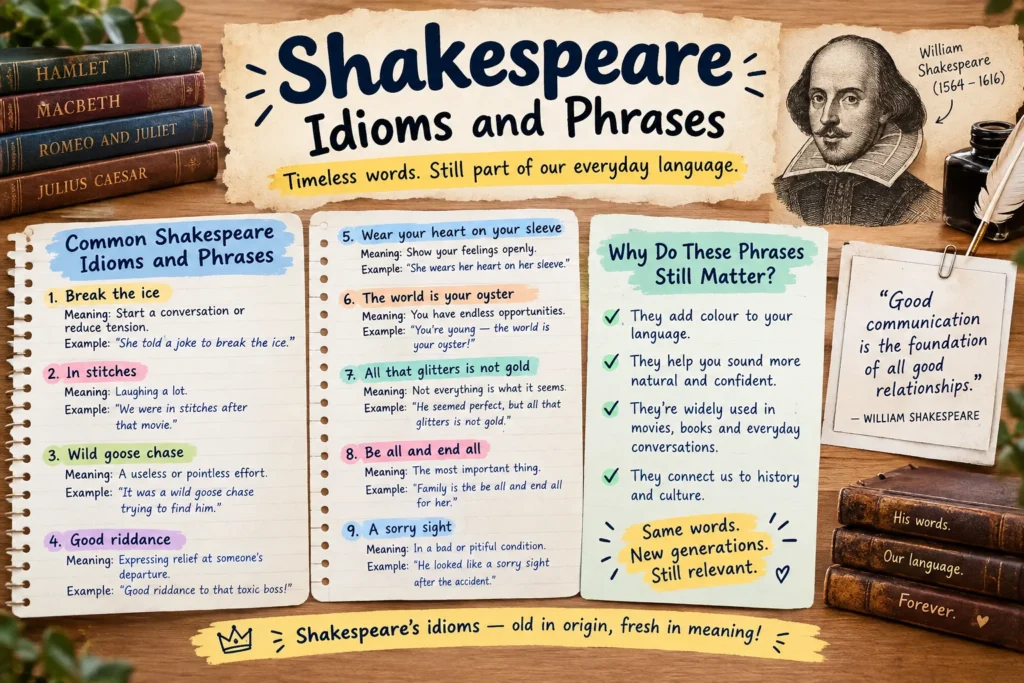
Shakespeare’s plays and poems are filled with memorable idioms, phrases, and expressions that remain part of English today. From “break the ice” to “wild-goose chase” and “heart of gold,” many familiar expressions appear in Shakespeare’s works and are still used in everyday English. Their meanings may seem simple now, but their connection to Shakespeare makes their history especially interesting.
There is one important detail, though: Shakespeare did not necessarily invent every phrase associated with his writing. Some expressions existed before his time, while his plays helped popularize them or brought them wider attention. So, saying a phrase is “from Shakespeare” does not always mean he was the first person to use it.
This guide explores common Shakespeare idioms and phrases, with their simple meanings, examples, literary sources, and historical background. You’ll also see which expressions are commonly credited to Shakespeare, which predate his works, and how these famous Shakespearean phrases are used today.
What Are Shakespeare Idioms and Phrases?
Shakespeare idioms and phrases are memorable expressions from, or strongly associated with, William Shakespeare’s plays and poetry that remain recognizable in modern English. Famous examples include “break the ice,” “in a pickle,” “heart of gold,” and “the world is my oyster.”
Shakespeare did not necessarily invent every expression attributed to him. Some existed earlier, while others were first recorded, popularized, or given memorable literary form through his works. That distinction matters when discussing Shakespeare’s influence on English.
Why Are Shakespeare’s Phrases Still Used Today?
More than four centuries later, many Shakespearean expressions remain useful because they describe everyday experiences in short, vivid ways.
Consider these examples:
- Break the ice → make an awkward situation more comfortable
- In a pickle → be in a difficult situation
- Heart of gold → be genuinely kind
- Foregone conclusion → an almost certain result
- Wear your heart on your sleeve → show your emotions openly
Some are so common that speakers may use them without realizing their Shakespearean connection.
Shakespeare Idioms vs. Shakespeare Quotes
Not everything Shakespeare wrote is an idiom.
An idiom usually has a figurative meaning that cannot be understood simply by interpreting every word literally. A phrase or quotation can be memorable without functioning as a modern idiom.
That is why the list below includes idioms, expressions, and famous phrases associated with Shakespeare, rather than incorrectly labeling every quotation an idiom.
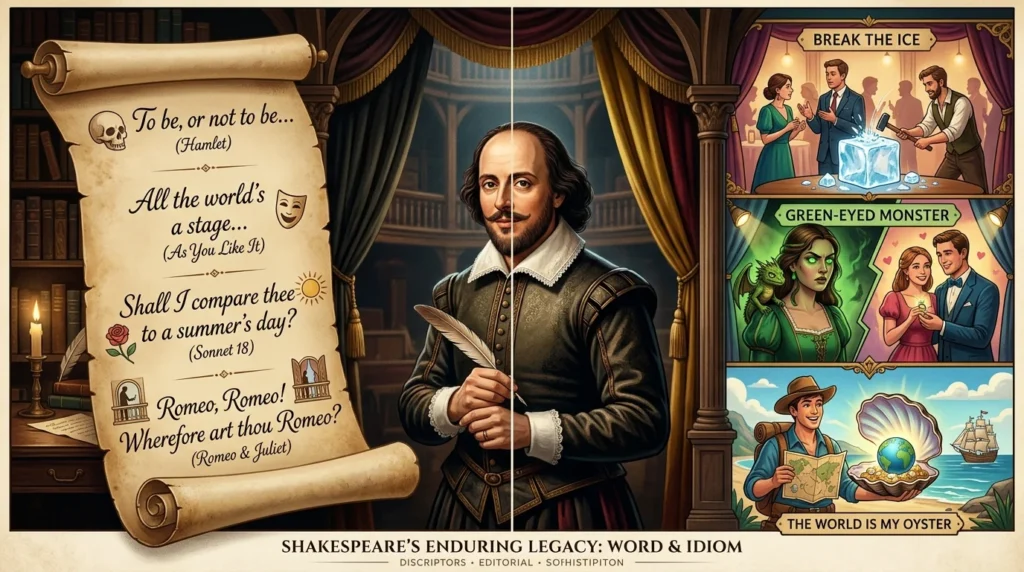
Break the Ice
Shakespearean source: The Taming of the Shrew
Meaning: To make people feel more relaxed when a situation is awkward or unfamiliar.
Example:
“I told a quick joke to break the ice before the meeting started.”
Common mistake: Don’t use it simply to mean “start talking.” The expression usually involves reducing tension or awkwardness.
Usage note: This is one of the most natural Shakespeare-associated expressions in modern everyday English.
The World Is My Oyster
Shakespearean source: The Merry Wives of Windsor
Meaning: To have many opportunities and the freedom to pursue them.
Example:
“Now that she has graduated, she feels the world is her oyster.”
Common mistake: It is about opportunity, not literally about oysters.
Usage note: The modern form often changes my to your, his, her, or their depending on the subject.
Wild-Goose Chase
Shakespearean source: Romeo and Juliet
Meaning: A pointless, difficult, or unsuccessful search.
Example:
“Looking for the missing receipt became a wild-goose chase.”
Common mistake: A long search isn’t automatically a wild-goose chase. The phrase suggests the search is unlikely to succeed or is misdirected.
Usage note: Shakespeare used an expression that already had an earlier history; his use helped preserve and popularize its figurative sense.
Green-Eyed Monster
Shakespearean source: Othello
Meaning: Jealousy or envy, especially when it becomes destructive.
Example:
“Don’t let the green-eyed monster ruin your friendship.”
Common mistake: It does not describe someone’s literal eye color.
Usage note: It is more colorful and dramatic than simply saying “jealousy.”
In a Pickle
Shakespearean source: The Tempest
Meaning: To be in a difficult, confusing, or troublesome situation.
Example:
“I’m in a pickle because I accidentally sent the email to the wrong person.”
Common mistake: Don’t use it for every minor inconvenience. It works best when someone is genuinely stuck or facing a problem.
Usage note: This is an informal expression and can have a humorous tone. Shakespeare helped popularize the expression, although it was not necessarily his invention.
All That Glitters Is Not Gold
Shakespearean source: The Merchant of Venice
Meaning: Something that looks attractive or valuable may not actually be good or worthwhile.
Example:
“The job sounded perfect, but the working conditions were terrible. All that glitters is not gold.”
Common mistake: Don’t limit it to money or jewelry.
Usage note: Shakespeare’s original wording uses “glisters,” while “glitters” is the familiar modern form.
Love Is Blind
Shakespearean source: The Merchant of Venice
Meaning: Love can cause people to overlook someone’s faults or warning signs.
Example:
“She ignored every warning because love is blind.”
Common mistake: It does not mean love literally prevents someone from seeing.
Usage note: It can be serious, humorous, or critical depending on context.
Heart of Gold
Shakespearean source: Henry V
Meaning: A person who is extremely kind, generous, and compassionate.
Example:
“He may seem strict, but he has a heart of gold.”
Common mistake: It describes character, not wealth.
Usage note: It is a warm compliment and remains common in modern English.
Seen Better Days
Shakespearean source: As You Like It
Meaning: To be in worse condition now than in the past.
Example:
“That old house has definitely seen better days.”
Common mistake: It doesn’t necessarily mean something is completely ruined.
Usage note: You can use it for objects, places, and situations.
Tongue-Tied
Shakespearean source: King Lear
Meaning: Unable to speak easily because of nervousness, embarrassment, surprise, or emotion.
Example:
“I became tongue-tied when I had to speak in front of hundreds of people.”
Common mistake: It usually describes temporary difficulty expressing yourself, not a permanent speech condition.
Usage note: This remains a natural expression in everyday English.
Good Riddance
Shakespearean source: Troilus and Cressida
Meaning: Relief or satisfaction that someone or something unwanted has gone.
Example:
“The broken printer finally stopped working—and good riddance!”
Common mistake: Be careful when saying it about a person because it can sound rude or hostile.
Usage note: The expression is still common but often carries a strong emotional tone.
Strange Bedfellows
Shakespearean source: The Tempest
Meaning: Unexpected people or groups who form an unlikely partnership or alliance.
Example:
“The two rival businesses became strange bedfellows after discovering a shared goal.”
Common mistake: It normally refers to an unexpected alliance, not literal sleeping arrangements.
Usage note: It is especially useful when describing surprising partnerships.
Brave New World
Shakespearean source: The Tempest
Meaning: A new and unfamiliar world or situation, often involving major change.
Example:
“Artificial intelligence is taking us into a brave new world of possibilities.”
Common mistake: The phrase does not always mean the new world is positive.
Usage note: Modern writers often use it ironically, especially when discussing technology or social change.
Foregone Conclusion
Shakespearean source: Othello
Meaning: An outcome that seems certain before it officially happens.
Example:
“With their strongest players injured, their defeat looked like a foregone conclusion.”
Common mistake: Don’t use it for something merely possible. It implies strong certainty.
Usage note: It is common in business, sports, journalism, and everyday discussion.
Wear Your Heart on Your Sleeve
Shakespearean source: Othello
Meaning: To show your feelings openly instead of hiding them.
Example:
“She wears her heart on her sleeve, so everyone knows when she’s excited or upset.”
Common mistake: The phrase refers to emotional openness, not clothing.
Usage note: The modern form is usually “wear your heart on your sleeve.”
Method in the Madness
Shakespearean source: Hamlet
Meaning: There is a logical plan behind behavior that appears chaotic, strange, or irrational.
Example:
“My workspace looks messy, but there is method in my madness.”
Common mistake: It doesn’t mean someone is genuinely mentally ill.
Usage note: The expression is often playful or humorous when defending an unusual approach.
At One Fell Swoop
Shakespearean source: Macbeth
Meaning: To accomplish or affect several things with one action.
Example:
“She solved three problems at one fell swoop.”
Common mistake: The correct expression is “at one fell swoop,” not “at one foul swoop.”
Usage note: It can sound slightly dramatic or formal, but it remains understandable and useful.
Laughing Stock
Shakespearean source: The Merry Wives of Windsor
Meaning: A person or thing that becomes an object of public ridicule.
Example:
“The team’s repeated mistakes turned them into a laughing stock.”
Common mistake: It does not mean someone who simply enjoys laughing.
Usage note: The phrase existed in earlier forms, so Shakespeare should not automatically be credited with inventing it; his use helped establish it in literary English.
Star-Crossed Lovers
Shakespearean source: Romeo and Juliet
Meaning: Lovers whose relationship is doomed or opposed by circumstances beyond their control.
Example:
“The novel tells the story of two star-crossed lovers separated by their families.”
Common mistake: It does not simply mean “a couple who loves each other.”
Usage note: This expression is strongly literary and is especially associated with tragic romance.
Too Much of a Good Thing
Shakespearean source: As You Like It
Meaning: Even something enjoyable or beneficial can become unpleasant or harmful when there is too much of it.
Example:
“A little dessert is wonderful, but too much of a good thing can leave you feeling sick.”
Common mistake: The phrase is about excess, not about something being bad in itself.
Usage note: This remains a very natural expression in modern English.
Theater Idioms: 25+ Stage Expressions & What They Mean
Shakespeare Idioms and Phrases: Quick Reference
| Expression | Modern meaning |
|---|---|
| Break the ice | Reduce awkwardness |
| The world is my oyster | Have many opportunities |
| Wild-goose chase | Pointless search |
| Green-eyed monster | Jealousy |
| In a pickle | Difficult situation |
| All that glitters is not gold | Appearances can deceive |
| Love is blind | Love can hide faults |
| Heart of gold | Great kindness |
| Seen better days | Once in better condition |
| Tongue-tied | Unable to speak easily |
| Good riddance | Relief that something unwanted is gone |
| Strange bedfellows | Unexpected allies |
| Brave new world | New and unfamiliar situation |
| Foregone conclusion | Almost certain result |
| Wear your heart on your sleeve | Show emotions openly |
| Method in the madness | Hidden logic in apparent chaos |
| At one fell swoop | Accomplish several things at once |
| Laughing stock | Object of ridicule |
| Star-crossed lovers | Lovers facing a tragic fate |
| Too much of a good thing | Excess can become harmful |
Which Shakespeare Phrases Are Still Common Today?
Not all Shakespearean expressions have the same level of everyday use.
Very common
- Break the ice
- Heart of gold
- Love is blind
- In a pickle
- Too much of a good thing
- Seen better days
Common but somewhat more expressive
- The world is my oyster
- Foregone conclusion
- Wild-goose chase
- Wear your heart on your sleeve
- At one fell swoop
More literary or dramatic
- Star-crossed lovers
- Brave new world
- Strange bedfellows
- Green-eyed monster
- Method in the madness
Knowing this difference helps you sound natural. You don’t need to force a Shakespearean expression into every conversation; choose one that fits the situation and tone.
Did Shakespeare Really Invent These Expressions?
This is where many online lists become misleading.
Shakespeare is frequently credited with inventing phrases such as “break the ice,” “wear your heart on your sleeve,” and “green-eyed monster.” Some expressions may indeed have been coined or first recorded by him, while others were already circulating before Shakespeare used them.
For example, “wild-goose chase” had an earlier history, while Shakespeare’s use in Romeo and Juliet is an important early recorded example of its figurative sense. Similarly, “in a pickle” was not necessarily invented by Shakespeare, although his use helped popularize it.
So the safest and most accurate wording is:
Shakespeare coined some expressions, popularized others, and preserved many memorable phrases in writing that remain influential today.
Hollywood Idioms: 27+ Expressions From Movies & Their Meanings
How to Learn Shakespeare Idioms Naturally
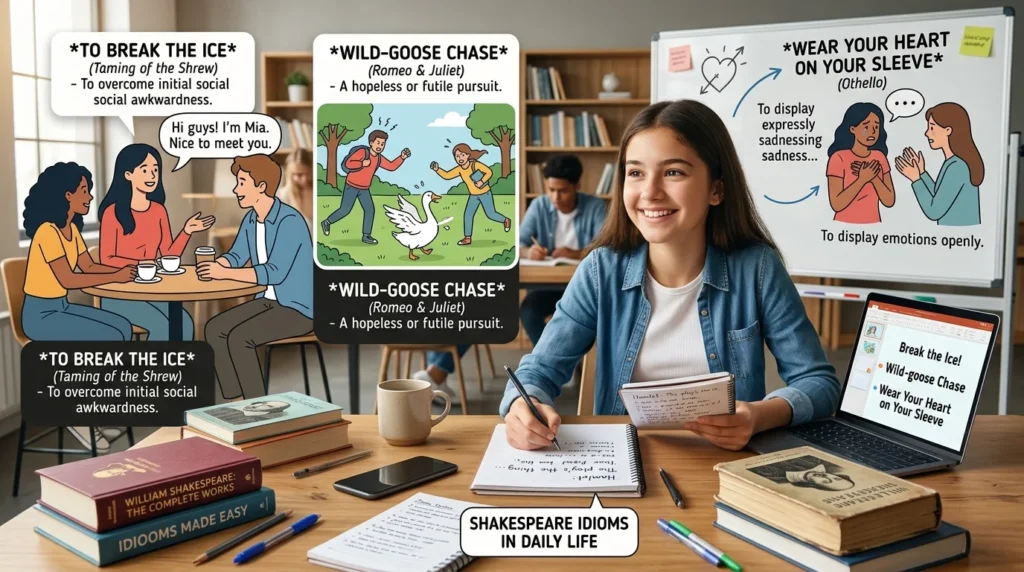
Don’t try to memorize all 20 at once.
Instead:
- Choose five expressions you are likely to use.
- Learn the figurative meaning rather than translating every word.
- Read each example aloud.
- Write one sentence about your own life.
- Pay attention to tone and context.
- Use the expressions naturally instead of forcing them into conversation.
For example, if you’re nervous before meeting new people, remember:
“I need to break the ice.”
If you’re facing a difficult situation:
“I’m in a bit of a pickle.”
Learning expressions through situations makes them much easier to remember.
Frequently Asked Questions
What are the most famous Shakespeare idioms?
Some of the best-known Shakespeare-associated expressions include “break the ice,” “the world is my oyster,” “wild-goose chase,” “green-eyed monster,” “in a pickle,” “heart of gold,” and “wear your heart on your sleeve.”
Did Shakespeare invent all these idioms?
No. Some expressions were already in use before Shakespeare. He coined some, popularized others, and provided early surviving written examples for many phrases.
Which Shakespeare phrase means “don’t judge by appearances”?
“All that glitters is not gold” means that something attractive or impressive may not be as valuable or good as it appears.
What does “break the ice” mean?
“Break the ice” means to make people feel more comfortable when a social situation is awkward, unfamiliar, or tense.
Are Shakespeare’s phrases still used today?
Yes. Many remain part of everyday English, while others are more literary or dramatic. Expressions such as “break the ice,” “heart of gold,” “foregone conclusion,” and “wild-goose chase” are still widely recognizable.
Shakespeare’s influence reaches far beyond the stage — explore our idioms in books guide for more literary phrases and British expressions and idioms for UK favorites. For everyday use, browse popular American idioms or start with our complete idioms with meanings and examples.
Final Thoughts
Shakespeare’s language has survived because many of his expressions capture familiar human experiences with remarkable clarity. Jealousy, love, opportunity, embarrassment, uncertainty, kindness, failure, and ambition are just as relevant today as they were centuries ago.
The best way to master these phrases is to use them in context. Start with five—such as “break the ice,” “heart of gold,” “in a pickle,” “foregone conclusion,” and “the world is my oyster.” Write your own examples, notice how native speakers use them, and gradually add more to your vocabulary.
Shakespeare may belong to another era, but his most memorable expressions are still very much alive in modern English.

Emily Carter writes for Meaning Match about English idioms, student-friendly expressions, and language learning, using simple explanations and helpful examples.
Pingback: Theater Idioms: 25+ Stage Expressions & What They Mean