
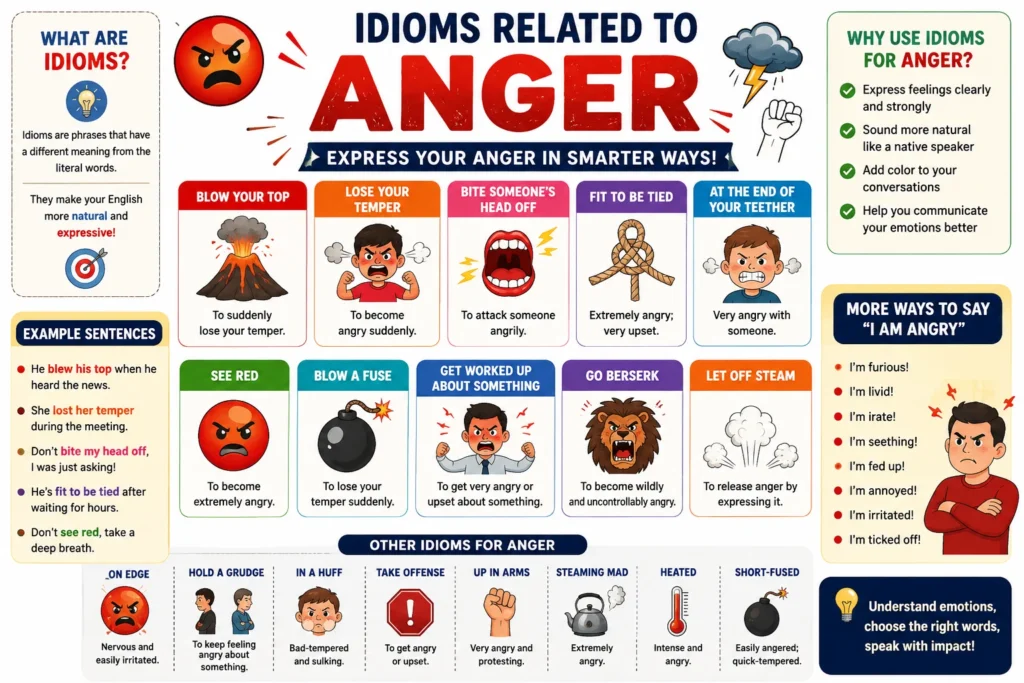
Looking for the perfect idiom to describe anger without simply saying “I’m angry”? English has dozens of vivid expressions for everything from mild irritation and frustration to intense anger and rage.
You might say someone is “seeing red” when they are extremely angry, “lose their temper” when they suddenly become upset, or “blow a fuse” when their frustration erupts. Other expressions, such as “get hot under the collar,” “have steam coming out of your ears,” “hit the roof,” “fly off the handle,” and “go ballistic,” bring humor, imagery, and emotional intensity to everyday English.
But these expressions are not interchangeable: some describe growing frustration, others suggest a sudden loss of control, while some emphasize extreme anger. This guide explores the best idioms for anger, frustration, irritation, and rage, with clear meanings, natural examples, tone and intensity notes, and practical explanations to help you choose the right expression for every situation.
What Are Anger Idioms?
Anger idioms are fixed or figurative English expressions used to describe anger, irritation, frustration, losing your temper, or an intense emotional reaction. Common examples include see red, lose your temper, hit the roof, blow a fuse, and fly off the handle.
Imagine someone cancels an important plan at the last minute. You might be annoyed. But if someone damages something valuable and refuses to apologize, you could say you were seeing red. These expressions help you communicate not only that you are angry, but also how angry you are and how you react.
In this guide, you’ll discover 28 common anger idioms in English, including their literal images, figurative meanings, example sentences, common learner mistakes, natural usage, and emotional intensity.
Quick answer: Some of the most common anger idioms are see red, lose your temper, blow a fuse, blow your top, hit the roof, go ballistic, fly off the handle, have a short fuse, get hot under the collar, lose your cool, and get on someone’s nerves.
Anger Idioms at a Glance
| # | Anger Idiom | Meaning | Intensity |
|---|---|---|---|
| 1 | See red | Become extremely angry | Very high |
| 2 | Lose your temper | Become angry and lose control | High |
| 3 | Blow a fuse | Become extremely angry | Very high |
| 4 | Blow your top | Become extremely angry | Very high |
| 5 | Hit the roof | Become extremely angry | Very high |
| 6 | Go ballistic | Become extremely angry or upset | Very high |
| 7 | Fly off the handle | Suddenly become very angry | High |
| 8 | Have a short fuse | Become angry easily | Medium–high |
| 9 | Get hot under the collar | Become angry or irritated | Medium–high |
| 10 | Be up in arms | Be very angry or upset about an issue | High |
| 11 | Bite someone’s head off | Speak angrily to someone | Medium–high |
| 12 | Ruffle someone’s feathers | Annoy or upset someone | Mild–medium |
| 13 | Rub someone the wrong way | Irritate someone | Mild–medium |
| 14 | Drive someone up the wall | Annoy or frustrate someone intensely | High |
| 15 | Get on someone’s nerves | Annoy someone | Mild–medium |
| 16 | Lose your cool | Stop being calm and become angry | High |
| 17 | Have steam coming out of your ears | Be extremely angry | Very high |
| 18 | Boil with rage | Feel intensely angry | Very high |
| 19 | Vent your anger | Express anger or frustration | Varies |
| 20 | Blow a gasket | Become extremely angry | Very high |
Note: These expressions do not all describe exactly the same thing. Some describe extreme anger, while others describe annoyance, angry reactions, or actions connected to conflict.
See Red
Word-by-word meaning
See means to perceive something with your eyes, and red is a color. Literally, the phrase suggests seeing the color red.
Idiomatic or figurative meaning
To see red means to become extremely angry.
The expression creates a vivid image of intense emotion taking over someone’s thoughts or reactions.
Example sentences
- I saw red when I discovered that someone had damaged my car.
- She was seeing red after being falsely accused.
- He saw red when he realized that someone had lied to him.
Natural dialogue
“Did you hear what he said?”
“Yes. I was seeing red.”
Common error
❌ I saw the red when he lied.
✅ I saw red when he lied.
Usage note
“See red” is informal and usually communicates strong or extreme anger. It is much stronger than simply saying “I was annoyed.”
Lose Your Temper
Word-by-word meaning
Lose means to no longer have or control something. Temper refers to a person’s emotional state, especially their tendency to become angry.
Idiomatic or figurative meaning
To lose your temper means to become angry and stop controlling your emotional reaction.
Example sentences
- I try not to lose my temper during disagreements.
- She lost her temper when the computer stopped working.
- He apologized after losing his temper with his colleague.
Natural dialogue
“Why did you shout at him?”
“I was frustrated and lost my temper. I shouldn’t have done that.”
Common error
❌ I lost my angry.
✅ I lost my temper.
Usage note
This is one of the most common anger expressions in everyday English. It can describe anything from a brief angry reaction to a serious outburst.
Blow a Fuse
Word-by-word meaning
An electrical fuse protects a circuit. When too much electrical current passes through it, the fuse can “blow.”
Idiomatic or figurative meaning
To blow a fuse means to become extremely angry.
The metaphor compares an angry person’s emotional reaction to an electrical system suddenly failing.
Example sentences
- Dad blew a fuse when he saw the broken window.
- My manager blew a fuse after discovering the mistake.
- She nearly blew a fuse when she received the unexpected bill.
Natural dialogue
“How did your boss react?”
“He completely blew a fuse.”
Common error
❌ He blew his angry fuse.
✅ He blew a fuse.
Usage note
This is an informal expression and works particularly well in conversational English.
Blow Your Top
Word-by-word meaning
A top can refer to the upper part of something. The literal image suggests the top suddenly flying off.
Idiomatic or figurative meaning
To blow your top means to become extremely angry or lose control of your emotions.
Example sentences
- My mother blew her top when she saw the mess.
- He blew his top after waiting for hours.
- I thought my boss was going to blow his top.
Natural dialogue
“Was she angry?”
“Angry? She nearly blew her top!”
Common error
❌ She blew the top.
✅ She blew her top.
Usage note
This is informal and dramatic. It is especially natural in stories and casual conversations.
Hit the Roof
Word-by-word meaning
A roof is the upper covering of a building. The literal image suggests someone’s anger becoming so intense that they metaphorically reach the roof.
Idiomatic or figurative meaning
To hit the roof means to become extremely angry.
Example sentences
- My parents will hit the roof if they find out what happened.
- She hit the roof when she saw the bill.
- He hit the roof after discovering that his car had been damaged.
Natural dialogue
“Are your parents going to be angry?”
“They’ll hit the roof when they hear about this.”
Common error
❌ He hit on the roof.
✅ He hit the roof.
Usage note
“Hit the roof” usually emphasizes a strong, explosive reaction.
Go Ballistic
Word-by-word meaning
Ballistic is related literally to the movement of projectiles.
Idiomatic or figurative meaning
To go ballistic means to become extremely angry, upset, or emotionally out of control.
Example sentences
- My boss went ballistic when the deadline was missed.
- She went ballistic after discovering that her files were deleted.
- He’ll go ballistic if he finds out what happened.
Natural dialogue
“What happened when you told him?”
“He went ballistic.”
Common error
❌ He went ballistically.
✅ He went ballistic.
Usage note
“Go ballistic” is informal and dramatic. It is best when the reaction is particularly intense.
Fly Off the Handle
Word-by-word meaning
A handle can be part of a tool. Something that flies off its handle suddenly becomes detached.
Idiomatic or figurative meaning
To fly off the handle means to suddenly become very angry.
Example sentences
- He flew off the handle when I questioned his decision.
- She tends to fly off the handle over small problems.
- I didn’t mean to make him fly off the handle.
Natural dialogue
“Why did he suddenly start shouting?”
“I’m not sure. He just flew off the handle.”
Common error
❌ He flew from the handle.
✅ He flew off the handle.
Usage note
The key idea is sudden anger. Someone who regularly reacts this way may also be described as having a short fuse.
Have a Short Fuse
Word-by-word meaning
A fuse can burn before something reacts. A short fuse suggests that the reaction happens quickly.
Idiomatic or figurative meaning
To have a short fuse means to become angry easily or quickly.
Example sentences
- My brother has a short fuse, so he gets irritated easily.
- She has always had a short fuse.
- He has a short fuse when he’s under pressure.
Natural dialogue
“Why does he get angry so quickly?”
“He has a short fuse.”
Common error
❌ He has short fuses.
✅ He has a short fuse.
Usage note
Unlike “lose your temper,” this expression describes a person’s general tendency to become angry quickly.
Get Hot Under the Collar
Word-by-word meaning
The area under your collar may feel warm when your body becomes hot.
Idiomatic or figurative meaning
To get hot under the collar means to become angry, irritated, or upset.
Example sentences
- She got hot under the collar when they criticized her work.
- Don’t get hot under the collar over such a small issue.
- He gets hot under the collar whenever someone challenges his opinion.
Natural dialogue
“Why is he so upset?”
“That topic always gets him hot under the collar.”
Common error
❌ He became hot below his collar.
✅ He got hot under the collar.
Usage note
This expression can describe anger or strong irritation, but it does not always suggest extreme rage.
Be Up in Arms
Word-by-word meaning
The phrase creates the image of people raising their arms as if they are preparing to fight.
Idiomatic or figurative meaning
To be up in arms means to be very angry or upset about something, especially something considered unfair or unacceptable.
Example sentences
- Residents are up in arms about the proposed changes.
- Parents were up in arms over the new school policy.
- Customers were up in arms after the sudden price increase.
Natural dialogue
“Why is everyone complaining?”
“The customers are up in arms about the new fees.”
Common error
❌ They were up on arms.
✅ They were up in arms.
Usage note
This expression is particularly useful when a group of people is angry about an issue.
Bite Someone’s Head Off
Word-by-word meaning
Literally biting someone’s head off would be an extremely aggressive action.
Idiomatic or figurative meaning
To bite someone’s head off means to respond to someone angrily or impatiently.
Example sentences
- I only asked a question. Don’t bite my head off.
- She bit my head off when I asked whether she needed help.
- Sorry for biting your head off earlier.
Natural dialogue
“Do you need help?”
“No!”
“Okay, you don’t have to bite my head off.”
Common error
❌ He bit off my head.
✅ He bit my head off.
Usage note
This expression focuses on how someone speaks to another person, rather than simply describing their emotional state.
Ruffle Someone’s Feathers
Word-by-word meaning
To ruffle feathers means to disturb or mess them up.
Idiomatic or figurative meaning
To ruffle someone’s feathers means to annoy, irritate, or upset someone.
Example sentences
- His criticism really ruffled her feathers.
- I didn’t mean to ruffle your feathers.
- The announcement ruffled a few feathers among employees.
Natural dialogue
“Did I upset you?”
“A little. Your comment definitely ruffled my feathers.”
Common error
❌ I ruffled his feather.
✅ I ruffled his feathers.
Usage note
This expression is generally milder than “make someone furious.”
Rub Someone the Wrong Way
Word-by-word meaning
Rubbing something in the wrong direction can feel uncomfortable or unpleasant.
Idiomatic or figurative meaning
To rub someone the wrong way means to annoy or irritate them.
Example sentences
- His arrogant attitude rubbed me the wrong way.
- Something about his behavior rubbed her the wrong way.
- I don’t know why, but that comment rubbed me the wrong way.
Natural dialogue
“Did you like the new manager?”
“Not really. Something about his attitude rubbed me the wrong way.”
Common error
❌ He rubbed me on the wrong way.
✅ He rubbed me the wrong way.
Usage note
This often describes a personal feeling of irritation or discomfort, not extreme anger.
Drive Someone Up the Wall
Word-by-word meaning
The literal image is of driving someone toward or up a wall.
Idiomatic or figurative meaning
To drive someone up the wall means to annoy, frustrate, or irritate someone intensely.
Example sentences
- That constant noise is driving me up the wall.
- His endless complaints drive me up the wall.
- Slow internet can drive people up the wall.
Natural dialogue
“Why are you so frustrated?”
“This constant noise is driving me up the wall.”
Common error
❌ This drives me at the wall.
✅ This drives me up the wall.
Usage note
The expression usually communicates strong annoyance or frustration, rather than pure rage.
Get on Someone’s Nerves
Word-by-word meaning
Your nerves are part of your nervous system.
Idiomatic or figurative meaning
To get on someone’s nerves means to annoy or irritate them.
Example sentences
- His constant tapping is getting on my nerves.
- That repetitive sound really gets on my nerves.
- Don’t let small problems get on your nerves.
Natural dialogue
“Why did you leave the room?”
“That noise was getting on my nerves.”
Common error
❌ He gets in my nerves.
✅ He gets on my nerves.
Usage note
This is one of the most natural everyday expressions for annoyance.
Lose Your Cool
Word-by-word meaning
Cool can literally mean having a low temperature, but here it represents calmness and self-control.
Idiomatic or figurative meaning
To lose your cool means to stop staying calm and become angry or upset.
Example sentences
- I tried to stay calm, but eventually I lost my cool.
- Don’t lose your cool during the meeting.
- She lost her cool after being interrupted several times.
Natural dialogue
“Were you angry?”
“Yes, but I tried not to lose my cool.”
Common error
❌ He lost his cooling.
✅ He lost his cool.
Usage note
“Lose your cool” is informal and common in conversational English.
Have Steam Coming Out of Your Ears
Word-by-word meaning
The literal image is of steam escaping from someone’s ears.
Idiomatic or figurative meaning
This humorous expression describes someone who is extremely angry.
Example sentences
- She looked like she had steam coming out of her ears.
- Dad had steam coming out of his ears after seeing the damage.
- I could tell he was furious; he looked as if he had steam coming out of his ears.
Natural dialogue
“Is Dad angry?”
“Very. He practically has steam coming out of his ears.”
Common error
❌ Steam is coming from his ear.
✅ He looks like he has steam coming out of his ears.
Usage note
This is vivid and often humorous. It works particularly well in storytelling and informal conversation.
Boil With Rage
Word-by-word meaning
To boil means to become extremely hot. Rage means intense anger.
Idiomatic or figurative meaning
To boil with rage means to feel extremely angry.
Example sentences
- She was boiling with rage after hearing the accusation.
- He boiled with rage but tried to remain calm.
- I could see that she was boiling with rage.
Natural dialogue
“How did she feel after hearing the news?”
“She was absolutely boiling with rage.”
Common error
❌ He boiled from rage.
✅ He boiled with rage.
Usage note
This expression is particularly effective in descriptive and narrative writing.
Vent Your Anger
Word-by-word meaning
To vent means to release something through an opening.
Idiomatic or figurative meaning
To vent your anger means to express anger or frustration instead of keeping those feelings inside.
Example sentences
- He called his friend to vent his anger.
- She needed some time to vent her frustration.
- Talking about the problem helped me vent my anger.
Natural dialogue
“Why did you call her?”
“I just needed to vent my frustration.”
Common error
❌ He vented his angry.
✅ He vented his anger.
Usage note
“Vent” can be used with many emotions and feelings, including anger, frustration, disappointment, and stress. It describes expressing an emotion, not necessarily becoming angry.
Blow a Gasket
Word-by-word meaning
A gasket is a mechanical component that helps seal a joint. The literal image suggests something in a machine suddenly failing under pressure.
Idiomatic or figurative meaning
To blow a gasket means to become extremely angry or lose emotional control.
Example sentences
- My dad blew a gasket when he saw the damage.
- She nearly blew a gasket when the same mistake happened again.
- The manager blew a gasket after discovering that the deadline had been ignored.
Natural dialogue
“How did he react?”
“He absolutely blew a gasket.”
Common error
❌ He blew the gasket with me.
✅ He blew a gasket.
Usage note
This is an informal, dramatic expression. It is especially useful when describing a very strong angry reaction.
Get Bent Out of Shape
Word-by-word meaning
Something bent out of shape has been physically distorted.
Idiomatic or figurative meaning
To get bent out of shape means to become unnecessarily upset, annoyed, or angry.
Example sentences
- Don’t get bent out of shape over a small mistake.
- He got bent out of shape because we changed the meeting time.
- He gets bent out of shape whenever someone disagrees with him.
Natural dialogue
“Why is he so upset?” “He got bent out of shape over a minor change.”
Common error
❌ Don’t get bent from shape.
✅ Don’t get bent out of shape.
Usage note
This expression can suggest that the person’s reaction is stronger than the situation requires.
Best for: unnecessary annoyance or upset. Intensity: mild to medium.
Get Under Someone’s Skin
Word-by-word meaning
Something under your skin would literally be beneath its surface.
Idiomatic or figurative meaning
To get under someone’s skin means to annoy or bother someone deeply.
Example sentences
- His constant criticism really gets under my skin.
- Don’t let her comments get under your skin.
- The way he interrupts everyone gets under my skin.
Natural dialogue
“Why did you leave the room?” “His comments were getting under my skin.”
Common error
❌ He got inside my skin.
✅ He got under my skin.
Usage note
This expression often suggests that an annoyance stays in your thoughts and keeps bothering you.
Best for: persistent irritation. Intensity: mild to medium.
Throw a Fit
Word-by-word meaning
A “fit” can refer to a sudden episode or outburst.
Idiomatic or figurative meaning
To throw a fit means to have an angry or emotional outburst.
Example sentences
- The child threw a fit when his parents said no.
- She threw a fit after discovering the mistake.
- Don’t throw a fit over something so minor.
Natural dialogue
“What happened at the store?” “He threw a fit when they refused the refund.”
Common error
❌ She threw an angry fit. (The phrase already expresses an emotional outburst, so “angry” is often unnecessary.)
✅ She threw a fit.
Usage note
It can describe children or adults, but when used for adults it may sound critical or dismissive.
Best for: angry outbursts. Intensity: medium to high.
Make Someone’s Blood Boil
Word-by-word meaning
The expression creates the image of blood becoming extremely hot.
Idiomatic or figurative meaning
To make someone’s blood boil means to make someone extremely angry.
Example sentences
- His dishonesty makes my blood boil.
- Seeing people treated unfairly makes her blood boil.
- That arrogant comment really made my blood boil.
Natural dialogue
“How did you feel about his lies?” “They made my blood boil.”
Common error
❌ This boils my bloods.
✅ This makes my blood boil.
Usage note
It is particularly effective when something causes strong emotional or moral anger.
Best for: deep anger about behavior or injustice. Intensity: very high.
Be on the Warpath
Word-by-word meaning
A “warpath” is a path associated with going to war.
Idiomatic or figurative meaning
To be on the warpath means to be extremely angry and ready to confront or deal with a problem.
Example sentences
- The manager is on the warpath after discovering the mistake.
- Mom was on the warpath after seeing the damaged furniture.
- The teacher was on the warpath after several students ignored the rules.
Natural dialogue
“Is the boss angry today?” “Yes, she’s on the warpath.”
Common error
❌ He is on a war road.
✅ He is on the warpath.
Usage note
This expression emphasizes not only anger but also a willingness to take action.
Best for: someone angry and ready to confront an issue. Intensity: high.
Tear Someone Apart
Word-by-word meaning
Literally, to tear something apart means to separate it forcefully.
Idiomatic or figurative meaning
To tear someone apart means to criticize someone very harshly.
Example sentences
- The critics tore the actor apart after the performance.
- My boss tore me apart for missing the deadline.
- The review tore the movie apart.
Natural dialogue
“How was the review?” “Brutal. They tore him apart.”
Common error
Don’t automatically assume this expression means simply “be angry.” It specifically describes harsh criticism.
✅ They tore his argument apart.
Usage note
Context is important. It can refer to harsh criticism, while in other contexts it can have a literal meaning.
Best for: harsh criticism. Intensity: high.
Give Someone an Earful
Word-by-word meaning
An “earful” humorously suggests giving someone’s ears a lot to hear.
Idiomatic or figurative meaning
To give someone an earful means to scold, criticize, or complain angrily to them.
Example sentences
- Dad gave me an earful after I missed the bus.
- The customer gave the manager an earful.
- I got an earful when I came home late.
Natural dialogue
“How did your dad react?” “He gave me an earful.”
Common error
❌ She gave me an ear.
✅ She gave me an earful.
Usage note
This is informal and often implies a long or intense verbal complaint.
Best for: angry complaints or scolding. Intensity: medium to high.
Hold a Grudge
Word-by-word meaning
A “grudge” is a feeling of resentment rather than a physical object you can literally hold.
Idiomatic or figurative meaning
To hold a grudge means to continue feeling angry or resentful toward someone because of something that happened in the past.
Example sentences
- I don’t hold a grudge against him.
- She still holds a grudge over what happened years ago.
- Try to forgive instead of holding a grudge.
Natural dialogue
“Are you still angry with him?” “No, I don’t hold a grudge.”
Common error
❌ I keep a grudge on him.
✅ I hold a grudge against him.
Usage note
This is different from “lose your temper.” A person can remain resentful for a long time without having an angry outburst.
Best for: long-lasting resentment.
Angry Idioms in Workplace English
Not every idiom for being mad belongs in a professional email.
More natural in casual workplace conversation: lose your cool, hold a grudge, get under someone’s skin, get bent out of shape.
Example: “I was frustrated, but I didn’t want to lose my cool during the meeting.”
More informal (too casual for formal writing): go ballistic, blow your top, throw a fit.
Instead of “The client went ballistic,” a professional report could say “The client became extremely upset.”
Best rule: In formal emails, reports, or business documents, plain vocabulary such as angry, frustrated, upset, dissatisfied, or concerned is usually clearer. Idioms are more natural in conversation, informal messages, storytelling, and casual workplace discussions.
Mad vs. Angry vs. Furious: What’s the Difference?
Mad: In American English, commonly means angry (“I’m mad at him”). In British English, it can also mean crazy or mentally unstable in certain contexts, so context matters.
Angry: The standard and widely understood word for feeling displeased or upset. (“She was angry about the decision.”)
Furious: Suggests very intense anger. (“He was furious when he found out.”)
Idioms add color: “She hit the roof” is more vivid than “She was angry.”
Idioms for Nervous: 25+ Expressions to Know
Anger Idioms by Category
Different anger idioms describe different emotional situations. Choosing the right one makes your English sound much more natural.
Idioms for Extreme Anger
Use these when someone is extremely angry:
- See red
- Blow a fuse
- Blow your top
- Hit the roof
- Go ballistic
- Have steam coming out of your ears
- Boil with rage
- Blow a gasket
Example
When he discovered that someone had stolen his work, he was seeing red.
Idioms for Losing Your Temper
These focus on losing emotional control:
- Lose your temper
- Fly off the handle
- Lose your cool
- Blow your top
Example
I was frustrated, but I tried not to lose my temper.
Idioms for Someone Who Gets Angry Easily
Use these to describe a person’s general tendency:
- Have a short fuse
- Fly off the handle
Example
He has a short fuse, so even small disagreements can upset him.
Idioms for Annoyance and Irritation
These are generally less intense than extreme anger:
- Get on someone’s nerves
- Rub someone the wrong way
- Ruffle someone’s feathers
- Drive someone up the wall
- Get hot under the collar
Example
The constant background noise is getting on my nerves.
Idioms for Angry Reactions
Some expressions describe how anger is communicated:
- Bite someone’s head off
- Vent your anger
- Lose your cool
Example
I was stressed, but I shouldn’t have bitten your head off.
Anger Idioms Ranked by Intensity
Understanding intensity is one of the most important parts of using these expressions correctly.
| Expression | Approximate intensity | Main idea |
|---|---|---|
| Ruffle someone’s feathers | Mild | Upset or annoy |
| Rub someone the wrong way | Mild–medium | Irritate |
| Get on someone’s nerves | Mild–medium | Annoy |
| Get hot under the collar | Medium | Become irritated or angry |
| Drive someone up the wall | Medium–high | Cause intense annoyance |
| Bite someone’s head off | Medium–high | Respond angrily |
| Have a short fuse | Medium–high | Get angry easily |
| Lose your cool | High | Stop being calm |
| Lose your temper | High | Lose emotional control |
| Fly off the handle | High | Suddenly become angry |
| Be up in arms | High | Strong group anger |
| See red | Very high | Become extremely angry |
| Hit the roof | Very high | Explosive anger |
| Blow your top | Very high | Extreme anger |
| Go ballistic | Very high | Extreme emotional reaction |
| Blow a fuse | Very high | Explosive anger |
| Blow a gasket | Very high | Explosive anger |
| Boil with rage | Very high | Intense internal anger |
Tip: Don’t automatically use the strongest idiom. Match the expression to the situation.
If your friend is mildly annoying you, say:
“You’re getting on my nerves.”
If someone seriously provokes you, you might say:
“I was seeing red.”
See Red vs. Lose Your Temper vs. Hit the Roof
These expressions are related, but they are not interchangeable in every situation.
| Idiom | What it emphasizes | Example |
|---|---|---|
| See red | Extreme anger | I was seeing red after hearing the accusation. |
| Lose your temper | Loss of emotional control | He lost his temper during the argument. |
| Hit the roof | Explosive angry reaction | Her parents hit the roof when they found out. |
| Fly off the handle | Sudden anger | He flew off the handle without warning. |
| Lose your cool | Stop staying calm | I almost lost my cool during the meeting. |
Easy way to remember them
See red = very angry
Lose your temper = lose control
Hit the roof = explosive reaction
Fly off the handle = sudden reaction
Lose your cool = stop being calm
How to Use Anger Idioms Naturally
Knowing the definition is only the first step. You also need to understand context, grammar, intensity, and tone.
Match the Idiom to the Situation
Small annoyance
“That constant tapping is getting on my nerves.”
Personal irritation
“His attitude rubbed me the wrong way.”
Sudden anger
“She flew off the handle when she heard the news.”
Losing control
“I lost my temper during the argument.”
Extreme anger
“He was seeing red after discovering what happened.”
Making conflict worse
“Don’t make another comment. You’ll only add fuel to the fire.”
Important: “Add fuel to the fire” is useful when talking about anger and conflict, but it is not included in the main 20 because it means making an existing problem or conflict worse, rather than directly meaning “be angry.”
Common Mistakes When Using Anger Idioms
Changing a Fixed Expression
Many idioms have relatively fixed wording.
❌ Hit the ceiling roof.
✅ Hit the roof.
❌ Get in my nerves.
✅ Get on my nerves.
❌ Fly from the handle.
✅ Fly off the handle.
Using the Wrong Pronoun
Some idioms require a possessive pronoun.
❌ She blew the top.
✅ She blew her top.
❌ I lost the cool.
✅ I lost my cool.
❌ He bit off my head.
✅ He bit my head off.
Confusing Anger With Annoyance
Not every anger expression describes extreme rage.
Compare:
“The noise is getting on my nerves.”
This suggests irritation.
Versus:
“I was seeing red.”
This suggests intense anger.
Using “see red” for every tiny annoyance can make your English sound exaggerated.
Translating Idioms Literally
English idioms usually cannot be understood by translating every word.
For example:
See red
does not mean that a person literally sees the color red.
Hit the roof
does not mean someone physically climbed onto a roof.
Learn each idiom as a complete expression with its figurative meaning.
Using Informal Idioms in Formal Writing
Many anger idioms are conversational.
In a casual conversation:
“He blew a fuse.”
works naturally.
In a formal report, you may prefer:
“He reacted angrily to the decision.”
Choose your vocabulary according to the audience and situation.
Why Do English Speakers Use Anger Idioms?
Idioms make communication more expressive.
Compare:
“She was angry.”
with:
“She was seeing red.”
The first statement gives you information.
The second creates an image and communicates emotional intensity.
Anger idioms can help speakers:
- describe emotions vividly
- make stories more engaging
- sound more natural in casual conversations
- understand movies and TV dialogue
- recognize figurative language
- distinguish different levels of anger
- communicate emotional reactions more precisely
How to Learn Anger Idioms Faster
Don’t try to memorize all 28 expressions in one sitting.
Learn Them in Groups
Start with five expressions:
Extreme anger
- See red
- Hit the roof
Losing control
- Lose your temper
- Lose your cool
Annoyance
- Get on someone’s nerves
This gives you a useful starting set without overwhelming you.
Learn the Whole Expression
Don’t memorize individual words.
Instead of learning:
lose = no longer have
temper = mood
learn:
Lose your temper = become angry and lose emotional control
This helps you remember both the meaning and the correct grammar.
Create Your Own Sentences
Take one idiom and connect it to a realistic situation.
For example:
I almost lost my cool when my internet stopped working during an important meeting.
Creating your own sentence makes the expression easier to remember.
Compare Similar Idioms
Learning differences is often more useful than learning isolated definitions.
For example:
Get on my nerves → annoyance
Lose my temper → anger and loss of control
See red → extreme anger
This teaches you when to choose one expression over another.
Practice: Choose the Correct Anger Idiom
Complete each sentence with the most appropriate expression.
- The constant noise is really __________.
- My father will __________ when he hears about the broken window.
- She becomes angry very quickly because she __________.
- I only asked a question. Don’t __________.
- He became extremely angry and was __________.
- I tried to remain calm, but eventually I __________.
- His arrogant behavior really __________.
- Don’t make another sarcastic comment. You’ll only __________.
Answers
- getting on my nerves
- hit the roof
- has a short fuse
- bite my head off
- seeing red
- lost my cool
- rubbed me the wrong way
- add fuel to the fire
Short Dialogue Practice
Situation 1: Mild annoyance
A: Why do you keep looking at the clock?
B: Because this meeting is driving me up the wall.
Situation 2: Sudden anger
A: What happened to Sam?
B: He flew off the handle when someone criticized his work.
Situation 3: Extreme anger
A: How did your manager react?
B: He went ballistic when he saw the report.
Situation 4: Apologizing after anger
A: Why did you speak to me like that?
B: I’m sorry. I lost my temper.
These short conversations show how anger idioms naturally appear in everyday English.
Anger Idioms vs. Simple English Words
Idioms are useful, but you don’t need an idiom in every sentence.
| Simple word | Related idiomatic expression |
|---|---|
| Angry | See red |
| Furious | Go ballistic |
| Become angry | Lose your temper |
| Lose control | Blow your top |
| Annoyed | Get on someone’s nerves |
| Irritated | Rub someone the wrong way |
| Frustrated | Drive someone up the wall |
| React angrily | Bite someone’s head off |
| Express anger | Vent your anger |
| Get angry easily | Have a short fuse |
The goal isn’t to replace every simple word with an idiom. The goal is to choose the expression that communicates the exact feeling and situation.
Idiom or Figurative Expression? A Quick Language Note
In everyday English-learning resources, the word “idiom” is often used broadly for fixed or figurative expressions.
Strictly speaking, not every expression in a list like this behaves in exactly the same linguistic way. Some are highly conventional idioms, while others are common figurative phrases or expressions associated with anger.
For learners, the most useful question is:
“What does this expression mean, and when would a natural English speaker use it?”
That approach is more practical than trying to memorize technical classifications.
Frequently Asked Questions About Anger Idioms
What are the most common anger idioms?
Some of the most common anger idioms include see red, lose your temper, blow a fuse, hit the roof, blow your top, go ballistic, fly off the handle, have a short fuse, and lose your cool.
What is an idiom for being extremely angry?
See red, hit the roof, blow your top, go ballistic, blow a fuse, and boil with rage can all describe very strong anger. The best choice depends on the context and tone.
What is an idiom for someone who gets angry easily?
Have a short fuse is one of the clearest expressions for someone who becomes angry quickly or easily.
What idiom means to lose your temper?
Lose your temper, fly off the handle, lose your cool, and blow your top can all describe becoming angry and losing some degree of emotional control.
What is an idiom for annoying someone?
Common expressions include get on someone’s nerves, rub someone the wrong way, ruffle someone’s feathers, and drive someone up the wall.
What is an idiom for making an angry situation worse?
Add fuel to the fire means to make an existing conflict, problem, or emotional situation worse. It does not directly mean “become angry.”
Anger is just one of many emotions with its own idioms — explore idioms about sadness for low moments, and calm idioms to cool down. See the full range in emotional idioms. For brighter days, explore idioms about being happy.
Final Thoughts on Anger Idioms
Learning anger idioms gives you more than a collection of colorful phrases. It helps you understand the difference between being mildly annoyed, becoming frustrated, losing your temper, and feeling intensely furious.
Start with five expressions instead of trying to memorize all 28:
get on someone’s nerves → have a short fuse → lose your temper → fly off the handle → see red
Then create one original sentence for each. After that, try using one naturally in a conversation, journal entry, or English-speaking practice session.
The more you connect an idiom with a real situation, emotional intensity, and complete sentence, the easier it becomes to remember and use naturally.
Don’t just memorize anger idioms—practice choosing the right one for the right situation.

Daniel Mercer is a Meaning Match writer covering English idioms, vocabulary, expressions, and language usage with clear meanings and practical examples.