
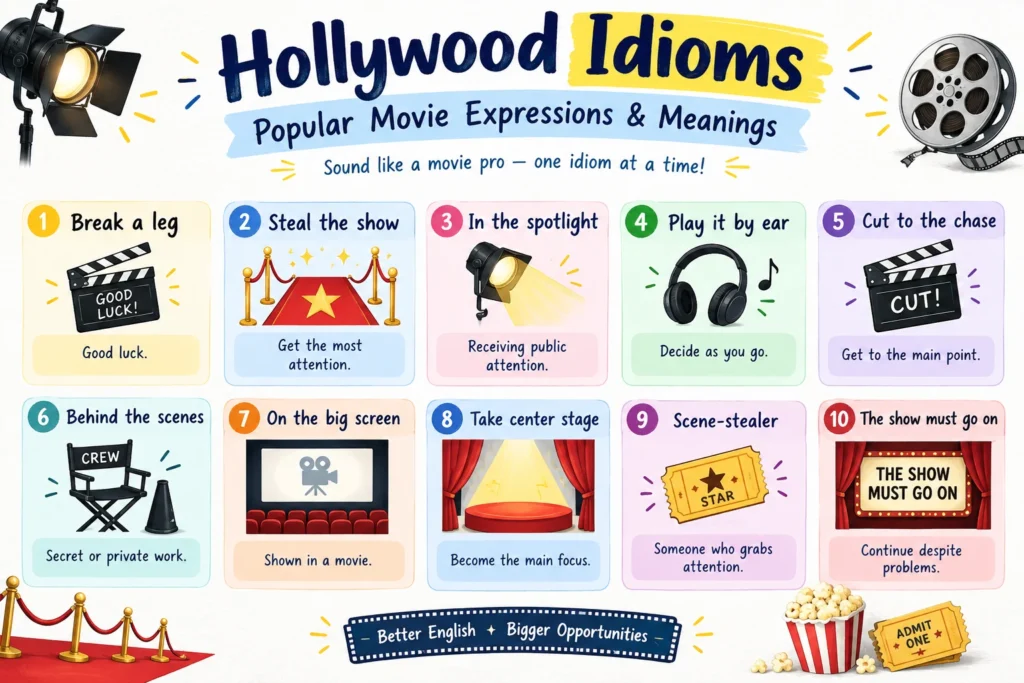
Ever heard a phrase in a Hollywood movie that made little sense literally but was easy to understand from the scene? Hollywood idioms are familiar idiomatic expressions commonly heard in movies and TV shows, whose intended meaning is often different from the literal meaning of the words. They can make dialogue sound more natural, emotional, humorous, and memorable.
For example, “break the ice” means to make people feel more comfortable, while “hit the road” means to leave or start a journey. Movies can help English learners understand how these expressions work naturally in dialogue and everyday situations.
However, not every famous Hollywood line is an idiom. Films also use slang, metaphors, catchphrases, and memorable quotes, which serve different purposes. This guide explores common Hollywood idioms, their simple meanings, examples, and the key differences between true idioms and other popular movie expressions.
What Are Hollywood Idioms?
Hollywood idioms are figurative expressions and commonly used phrases connected with movies, acting, fame, performances, and entertainment. Popular examples include “break a leg,” “steal the show,” “in the spotlight,” “get your big break,” “call the shots,” and “behind the scenes.”
Not every phrase on this list is technically an idiom. Some are fixed expressions, entertainment terms, or famous filmmaking phrases. They are included because learners commonly encounter them when talking about Hollywood and popular culture.
Famous Hollywood Idioms and Expressions at a Glance
| Expression | Simple Meaning |
|---|---|
| Break a leg | Good luck |
| Steal the show | Attract the most attention |
| In the spotlight | Receive public attention |
| Make it big | Become highly successful |
| Get your big break | Receive an important opportunity |
| Call the shots | Make the important decisions |
| Behind the scenes | Away from public view |
| The show must go on | Continue despite difficulties |
| Steal the limelight | Attract public attention |
| Upstage someone | Get more attention than another person |
| Walk the red carpet | Attend a prestigious event |
| Red carpet treatment | Receive special treatment |
| Rising star | A person becoming successful |
| Have star power | Have strong fame or audience appeal |
| Box-office hit | A highly successful movie |
| Typecast | Repeatedly given similar acting roles |
| Have a cameo | Make a brief appearance |
| Lights, camera, action! | Signal that filming begins |
| On the big screen | Shown in a cinema/movie |
| Glitz and glamour | The exciting, luxurious side of fame |
Break a Leg
Meaning
Break a leg is a traditional expression used to wish someone good luck before a performance, audition, or show.
The literal words sound negative, but the actual meaning is positive.
Examples
- “You have your first audition today? Break a leg!”
- “Everyone told the young actor to break a leg before the performance.”
Common mistake
Don’t interpret it as an instruction to physically hurt yourself.
Usage Note
It is especially associated with acting and theater, but people also use it humorously before presentations, competitions, and other important events.
Steal the Show
Meaning
Steal the show means to become the most impressive, memorable, or attention-grabbing part of an event.
Examples
- “The supporting actor stole the show with his performance.”
- “Her speech completely stole the show at the awards ceremony.”
Common mistake
It does not necessarily mean deliberately taking attention away from someone.
Usage Note
Use it when a person, performance, moment, or even an object becomes the highlight of an event.
In the Spotlight
Meaning
In the spotlight means receiving significant public attention, publicity, or scrutiny.
Examples
- “The actress has been in the spotlight since her new movie became successful.”
- “Celebrities often have to deal with life in the spotlight.”
Common mistake
The expression doesn’t require an actual stage spotlight.
Usage Note
It can describe positive attention, media interest, or unwanted public scrutiny.
Make It Big
Meaning
Make it big means becoming highly successful, particularly in a competitive career such as acting, music, sports, or entertainment.
Examples
- “She moved to Los Angeles hoping to make it big as an actress.”
- “After years of small roles, he finally made it big.”
Common mistake
It doesn’t mean physically making something larger.
Usage Note
This is an informal expression commonly used when discussing ambition and career success.
Get Your Big Break
Meaning
A big break is an important opportunity that can help someone achieve major success.
Examples
- “That television role gave her the big break she needed.”
- “The young actor is still waiting for his big break.”
Common mistake
A “big break” is not simply a long rest from work.
Usage Note
It is particularly useful when talking about the moment someone’s career begins to take off.
Call the Shots
Meaning
Call the shots means to have the authority to make important decisions or control a situation.
Examples
- “The director calls the shots on the set.”
- “Once she became the producer, she started calling the shots.”
Common mistake
Although the phrase can sound connected to filmmaking or cameras, its everyday meaning is to make the decisions.
Usage Note
It is informal and can be used far beyond Hollywood.
Behind the Scenes
Meaning
Behind the scenes refers to activities, people, or decisions that the public does not normally see.
Examples
- “Hundreds of people work behind the scenes to make a movie.”
- “The documentary shows what happened behind the scenes.”
Common mistake
It does not necessarily refer to a physical area behind a stage.
Usage Note
Use it for hidden preparation, production work, negotiations, or support that makes a visible result possible.
The Show Must Go On
Meaning
The show must go on means that something should continue despite problems, setbacks, or unexpected difficulties.
Examples
- “The lights stopped working, but the show must go on.”
- “We have had a difficult day, but the show must go on.”
Common mistake
It does not mean that serious problems should simply be ignored.
Usage Note
This expression works especially well when people need to keep going despite an obstacle.
Steal the Limelight
Meaning
Steal the limelight means to attract more public attention than someone else.
Examples
- “The young actress stole the limelight at the premiere.”
- “His unexpected announcement stole the limelight.”
Common mistake
It is closely related to “steal the show,” but the emphasis is slightly different.
Usage Note
Steal the show usually focuses on being the most impressive part of an event, while steal the limelight emphasizes receiving public attention.
Upstage Someone
Meaning
To upstage someone means to attract more attention than another person, particularly when that person was expected to be the main focus.
Examples
- “The comedian accidentally upstaged the host.”
- “The supporting actor nearly upstaged the lead.”
Common mistake
Upstaging does not always mean someone intentionally tried to steal attention.
Usage Note
It can happen naturally because someone gives a particularly memorable performance.
Walk the Red Carpet
Meaning
To walk the red carpet means to attend a prestigious public event, usually as a celebrity, performer, or special guest.
Examples
- “The actors walked the red carpet before the premiere.”
- “She was excited to walk the red carpet for the first time.”
Common mistake
It doesn’t simply mean walking on any red-colored carpet.
Usage Note
The expression is commonly associated with movie premieres, award ceremonies, and major entertainment events.
Red Carpet Treatment
Meaning
Red carpet treatment means giving someone especially generous, respectful, or luxurious treatment.
Examples
- “The visiting actor received the red carpet treatment.”
- “The hotel gave its guests red carpet treatment.”
Common mistake
The phrase does not require an actual red carpet.
Usage Note
Although strongly associated with Hollywood, it can describe VIP treatment in business, travel, hospitality, and everyday situations.
Rising Star
Meaning
A rising star is someone whose popularity, reputation, or success is increasing quickly.
Examples
- “The young actress is a rising star.”
- “He is considered one of the industry’s most promising rising stars.”
Common mistake
A rising star doesn’t have to be an established celebrity already.
Usage Note
The phrase works for actors, musicians, athletes, business leaders, and other talented people.
Have Star Power
Meaning
To have star power means to have enough fame, charisma, popularity, or influence to attract an audience.
Examples
- “The actress has enough star power to draw huge audiences.”
- “His star power helped generate interest in the film.”
Common mistake
Star power isn’t exactly the same as acting ability.
Usage Note
Someone can have star power because of fame, personality, audience loyalty, or overall public appeal.
Box-Office Hit
Meaning
A box-office hit is a movie that attracts large audiences and earns substantial revenue from ticket sales.
Examples
- “The film became an unexpected box-office hit.”
- “The action movie was one of the year’s biggest box-office hits.”
Common mistake
A box-office hit isn’t necessarily the same thing as a critically acclaimed movie.
Usage Note
A movie can receive excellent reviews without becoming a major commercial success, and the reverse can also happen.
Typecast
Meaning
To be typecast means to repeatedly be given the same kind of acting role because audiences or filmmakers associate an actor with that particular character type.
Examples
- “After playing several villains, he worried about being typecast.”
- “She accepted different roles because she didn’t want to be typecast.”
Common mistake
Being typecast does not mean an actor is untalented.
Usage Note
This is primarily an entertainment term rather than a traditional idiom, but it is important vocabulary for discussing acting careers.
Have a Cameo
Meaning
To have a cameo means to make a brief appearance in a movie, television show, or other production, often as a recognizable person.
Examples
- “The singer had a cameo in the comedy.”
- “The director made a short cameo in his own movie.”
Common mistake
A cameo is not the same as having a major supporting role.
Usage Note
Cameos are usually short and can be designed to surprise the audience or add humor.
Lights, Camera, Action!
Meaning
Lights, camera, action! is a famous filmmaking phrase traditionally used to signal that filming is about to begin.
Examples
- “The crew became quiet when the director called, ‘Lights, camera, action!’”
- “Everyone was ready for the big scene: lights, camera, action!”
Common mistake
It is primarily a filmmaking phrase, not a general idiom.
Usage Note
People also use it humorously when someone is about to perform, pose for photographs, or appear on camera.
On the Big Screen
Meaning
On the big screen means appearing in a cinema movie rather than simply on television, a phone, or another small display.
Examples
- “She dreamed of seeing herself on the big screen.”
- “The novel was eventually adapted for the big screen.”
Common mistake
“Big screen” refers to cinema/theatrical movies in this expression, not merely a physically large monitor.
Usage Note
This phrase is often used when discussing movies, actors, adaptations, and theatrical releases.
Glitz and Glamour
Meaning
Glitz and glamour refers to the exciting, fashionable, luxurious, and visually impressive side of celebrity and entertainment culture.
Examples
- “Many people dream about the glitz and glamour of Hollywood.”
- “Behind the glitz and glamour, filmmaking involves long hours and hard work.”
Common mistake
The expression does not suggest that every part of Hollywood is luxurious or easy.
Usage Note
It is especially useful when contrasting the glamorous public image of entertainment with the hard work behind it.
More Idioms Heard in Movies
Movie dialogue is full of everyday idioms too. These popular expressions appear in countless films, and learning them will help you follow movie conversations more easily.
Hit the Road
Meaning
To leave or begin a journey.
Examples
- “The storm is coming. Grab your bag and hit the road.”
- “It’s getting late; we should hit the road.”
Common mistake
It does not mean physically hitting a road.
Usage Note
Informal and often used when someone wants to leave.
Spill the Beans
Meaning
To reveal a secret.
Examples
- “Everyone already knows about the surprise. Just spill the beans!”
- “Who spilled the beans about the party?”
Common mistake
The established expression is “spill the beans,” not “pour the beans.”
Usage Note
Casual and conversational.
Piece of Cake
Meaning
Something very easy to do.
Examples
- “You think opening that old lock will be difficult? It’ll be a piece of cake.”
- “The test was a piece of cake.”
Common mistake
It describes difficulty, not food.
Usage Note
Informal and common in everyday speech.
Break the Ice
Meaning
To make people feel more comfortable in an awkward or unfamiliar situation.
Examples
- “Everyone looks nervous. Tell a joke and break the ice.”
- “A friendly greeting can break the ice at a party.”
Common mistake
Don’t use it simply to mean breaking physical ice.
Usage Note
Useful for first meetings, parties, classrooms, and uncomfortable situations.
Let the Cat Out of the Bag
Meaning
To reveal a secret, often accidentally.
Examples
- “I wasn’t supposed to tell you, but Maya let the cat out of the bag.”
- “Don’t let the cat out of the bag about the surprise.”
Common mistake
It is similar to “spill the beans,” but the expression should remain in its established form.
Usage Note
Informal and often used when a secret becomes known unexpectedly.
Once in a Blue Moon
Meaning
Very rarely.
Examples
- “We visit that little town once in a blue moon.”
- “I eat fast food once in a blue moon.”
Common mistake
Don’t use it for something that happens regularly.
Usage Note
Good for describing unusual or infrequent events.
Under the Weather
Meaning
Feeling slightly ill or unwell.
Examples
- “I’m staying home tonight. I’m feeling a little under the weather.”
- “She was under the weather all week.”
Common mistake
It usually describes feeling sick, not being caught in bad weather.
Usage Note
Casual and commonly used in everyday conversation.
A Blessing in Disguise
Meaning
Something that initially seems bad but eventually has a positive result.
Examples
- “Losing that job felt terrible, but finding this opportunity was a blessing in disguise.”
- “Missing the flight was a blessing in disguise.”
Common mistake
The positive result usually becomes clear later.
Usage Note
Useful when reflecting on an unexpected positive outcome.
Cost an Arm and a Leg
Meaning
Something costs a lot of money.
Examples
- “That mansion must have cost an arm and a leg.”
- “The repairs cost an arm and a leg.”
Common mistake
Don’t use it for something merely expensive unless the price feels unusually high.
Usage Note
Informal and often exaggerated for emphasis.
On the Same Page
Meaning
To have the same understanding, expectations, or plan.
Examples
- “Before we enter the building, let’s make sure we’re all on the same page.”
- “We need to get on the same page about the deadline.”
Common mistake
It is about agreement or understanding, not literally reading together.
Usage Note
Common in conversations about plans, teamwork, and decisions.
Get Cold Feet
Meaning
To become nervous or afraid before doing something important.
Examples
- “You were ready to confront him yesterday. Don’t get cold feet now.”
- “She got cold feet before the wedding.”
Common mistake
It normally refers to emotional hesitation rather than temperature.
Usage Note
Informal and useful for moments of doubt or nervousness.
In Hot Water
Meaning
To be in trouble.
Examples
- “If the police discover what happened, we’re going to be in hot water.”
- “He landed in hot water after missing the deadline.”
Common mistake
It does not necessarily involve actual water.
Usage Note
Casual and often used after a mistake or problematic action.
Hit the Nail on the Head
Meaning
To identify or describe something exactly.
Examples
- “You hit the nail on the head. Fear is the real reason he’s hiding.”
- “Her explanation hit the nail on the head.”
Common mistake
Use it when someone is exactly right about an idea or problem.
Usage Note
Often used to agree with an accurate observation.
Go the Extra Mile
Meaning
To make extra effort beyond what is normally expected.
Examples
- “She went the extra mile to help the new student.”
- “Our teacher went the extra mile to prepare us.”
Common mistake
It is about additional effort, not necessarily physical distance.
Usage Note
Can be positive and encouraging; common in work, school, and personal situations.
Pull Someone’s Leg
Meaning
To tease or joke with someone.
Examples
- “Relax! I’m just pulling your leg. There isn’t a monster outside.”
- “Were you serious, or were you pulling my leg?”
Common mistake
Don’t confuse playful teasing with serious deception.
Usage Note
Informal, playful, and often humorous.
Barking Up the Wrong Tree
Meaning
Pursuing the wrong idea, person, or explanation.
Examples
- “If you think I stole the money, you’re barking up the wrong tree.”
- “You’re barking up the wrong tree if you think Tom knows the answer.”
Common mistake
Use it when someone has made a mistaken assumption or is investigating the wrong direction.
Usage Note
Informal and particularly useful when correcting an accusation.
The Ball Is in Your Court
Meaning
It is now your responsibility or turn to act or decide.
Examples
- “I’ve made my offer. The ball is in your court now.”
- “I’ve shared all the information, so the ball is in your court.”
Common mistake
It is not limited to sports.
Usage Note
Can sound conversational or slightly businesslike depending on context.
Speak of the Devil
Meaning
Said when the person being discussed suddenly appears.
Examples
- “Speak of the devil! We were just talking about you.”
- “Well, speak of the devil — here he comes.”
Common mistake
In ordinary conversation, this expression is usually playful rather than a serious statement.
Usage Note
Casual and often humorous.
Keep an Eye on Something
Meaning
To watch, monitor, or look after someone or something.
Examples
- “Keep an eye on the door while I check the other room.”
- “Can you keep an eye on my bag for a minute?”
Common mistake
It means watch or monitor something, not physically move an eye.
Usage Note
Very common in everyday English and useful in practical situations.
Hollywood Idioms: Literal vs. Figurative Meaning
One of the easiest ways to learn these expressions is to compare what the words literally suggest with what the expression actually means.
| Expression | Literal Idea | Figurative Meaning |
|---|---|---|
| Break a leg | Injure a leg | Good luck |
| Steal the show | Take a show | Become the highlight |
| In the spotlight | Stand under a light | Receive attention |
| Get your big break | Have a large break | Get an important opportunity |
| Call the shots | Give shooting instructions | Make decisions |
| Behind the scenes | Be behind a stage | Work outside public view |
| Steal the limelight | Take a light | Attract public attention |
| The show must go on | Continue a performance | Keep going despite difficulties |
This is why translating idioms word for word can sometimes produce confusing results.
Hollywood Idioms You Can Use in Everyday English
You don’t have to work in Hollywood to use these expressions naturally.
Imagine your friend has spent years trying to become an actor and finally lands a major role. You could say:
“This could be your big break!”
If your colleague gives an outstanding presentation and everyone remembers it, you might say:
“You really stole the show.”
If your manager makes all the important decisions, you could say:
“She calls the shots around here.”
And if a team faces an unexpected problem but still needs to finish its work:
“The show must go on.”
These examples show how entertainment expressions can move naturally into everyday English.
Similar Hollywood Expressions: What’s the Difference?
Some expressions are easy to confuse because their meanings overlap.
Steal the Show vs. Steal the Limelight
- Steal the show → become the most impressive or memorable part of an event.
- Steal the limelight → attract the most public attention.
In the Spotlight vs. Steal the Limelight
- In the spotlight → receive attention.
- Steal the limelight → take more attention than another person or event.
Big Break vs. Rising Star
- Big break → an important opportunity.
- Rising star → a person whose success or popularity is growing.
Walk the Red Carpet vs. Red Carpet Treatment
- Walk the red carpet → attend a prestigious event.
- Red carpet treatment → receive unusually special treatment.
Understanding these small differences helps you sound more precise.
Common Mistakes When Using Hollywood Expressions
Don’t Take Every Expression Literally
If someone tells an actor to “break a leg,” they are wishing them luck.
Don’t Call Every Entertainment Phrase an Idiom
Some expressions are technically terms or fixed phrases rather than idioms. Typecast, cameo, box-office hit, and lights, camera, action are good examples.
Using the broader term “Hollywood idioms and expressions” is therefore more accurate.
Don’t Force an Idiom Into a Sentence
An idiom should sound natural in context. If a simple phrase works better, use the simple phrase.
Learn the Meaning With an Example
Instead of memorizing:
Big break = opportunity
remember:
“That role was her big break.”
The complete sentence helps you understand how the expression behaves in real English.
How to Learn Hollywood Idioms Naturally
Try these simple methods:
- Watch movies and interviews and write down expressions you hear repeatedly.
- Create your own sentences instead of memorizing definitions alone.
- Group similar expressions, such as fame, success, performance, and filmmaking.
- Practice aloud so the phrases become easier to recall.
- Compare similar expressions to understand their subtle differences.
- Use three new expressions in conversation rather than trying to memorize all 39 at once.
A simple challenge is to choose “big break,” “in the spotlight,” and “steal the show” today and create one sentence for each.
Idioms in Song Lyrics: 26+ Expressions & Their Meanings
Frequently Asked Questions About Hollywood Idioms
What are some popular Hollywood idioms?
Popular Hollywood idioms and expressions include “break a leg,” “steal the show,” “in the spotlight,” “make it big,” “get your big break,” “call the shots,” and “behind the scenes.”
What does “break a leg” mean in acting?
“Break a leg” means good luck. Actors traditionally use this expression before a performance or audition instead of directly saying “good luck.”
What does “steal the show” mean?
“Steal the show” means to become the most impressive or memorable part of an event or performance. It can describe an actor, speaker, performer, or even an unexpected moment.
What does “big break” mean in Hollywood?
A big break is an important career opportunity that can help an actor, musician, or other performer achieve greater success or recognition.
Can Hollywood idioms be used outside entertainment?
Yes. Many Hollywood-related expressions have become common everyday English. “Call the shots,” “behind the scenes,” “big break,” “in the spotlight,” and “the show must go on” can all be used in ordinary conversations.
Hollywood loves a good idiom — readers can explore idioms in books, Potter fans our Harry Potter idioms, and theater lovers our theater idioms. For everyday American expressions, see popular idioms in America.
Conclusion
Hollywood idioms and expressions make English more colorful because they turn ideas about success, attention, opportunity, performance, and fame into memorable phrases.
You don’t need to memorize all 39 today. Start with three—perhaps “break a leg,” “get your big break,” and “steal the show.” Write your own examples, notice them in movies and conversations, and gradually add more to your vocabulary.
The more you understand these expressions in context, the easier it becomes to recognize them, use them naturally, and enjoy the language of Hollywood with confidence.

Sophie Collins writes for Meaning Match about English idioms, American and British expressions, meanings, usage, and everyday language differences.